

Crypto markets endured a week of sharp reversals and shifting narratives. Bitcoin whipsawed between macro-driven rallies and sharp pullbacks, Zcash blasted back above $1,000 for the first time in nearly a decade, and capital continued flowing toward crypto’s more speculative corners. At the same time, Wall Street kept pushing deeper into the industry, with major banks building a stablecoin venture, the London Stock Exchange moving toward tokenized equities and Kraken parent Payward expanding its ties to traditional finance even as its IPO slips into 2027.
Crypto market consolidates as Zcash smashes back into four-figure territory
The crypto market spent the week consolidating after Bitcoin’s 25% August rally, with major assets largely range-bound and traders rotating into higher-beta narratives rather than pushing the entire altcoin market higher. Total crypto market capitalization remained around $2.7 trillion, reaching roughly $2.8 trillion at points during the week, while Bitcoin (BTC) dominance held near 58%.
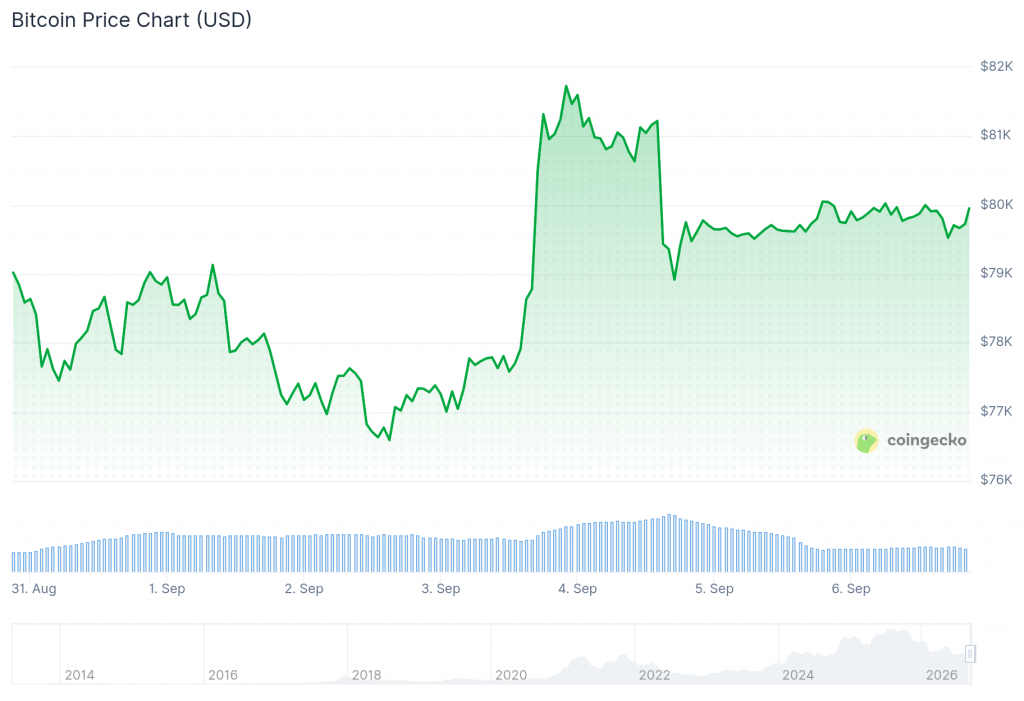
The largest cryptocurrency entered the week around $78,550, briefly slipped below $78,000 as September opened, and then staged a sharp reversal. By Thursday, Bitcoin had ripped from an overnight low near $77,000 to above $81,000 and briefly reached roughly $82,200—its highest intraday level since May—before giving back a large portion of those gains.
The whipsaw was largely a macro story. At the start of the week, rising oil prices and renewed U.S.-Iran tensions pushed Treasury yields higher and revived fears that the Federal Reserve could raise rates in September. Markets were also digesting hawkish comments from Fed officials, keeping Bitcoin pinned below the psychologically important $80,000 level.
Then the narrative flipped. Fed Governor Christopher Waller said he could support holding rates steady at the September meeting if inflation continues to improve, triggering a broad risk-asset rally. Bitcoin jumped above $81,000, while U.S. spot Bitcoin ETFs recorded more than $730 million of net inflows on Thursday, their strongest single day since January. The move was amplified by short covering, with more than $400 million in crypto shorts reportedly liquidated as BTC accelerated higher.
But the relief proved short-lived. Friday’s U.S. jobs report delivered another shock: August payrolls increased by 162,000, roughly three times the consensus estimate, while unemployment remained at 4.1%. Treasury yields jumped and the probability of a September Fed rate hike climbed back toward 60%, sending Bitcoin briefly below $80,000 after its $82,000-plus run.
By Sunday, Bitcoin had stabilized around $79,700-$79,900, leaving it only about up 0.5% over the week despite the considerable intraday swings. The action suggested that traders were unwilling to abandon the August rally, but were equally unwilling to chase it aggressively while the Fed’s next move remains uncertain. With August CPI due Sept. 11 and the Fed meeting scheduled for Sept. 15-16, another volatility trigger is already on the calendar.
| Put your Bitcoin price predictions to the test and build a track record — check out Glimpse, the Bitcoin-native prediction market. |
Ethereum (ETH) was similarly subdued, moving from around $2,467 to roughly $2,490, per CoinGecko.
Underneath Bitcoin’s relatively flat weekly performance, however, the market was anything but flat, with the strongest moves concentrated in a handful of ecosystem and narrative-driven tokens. PONS, the token associated with a launchpad on Robinhood Chain, surged roughly 181% for the week, while Arbitrum (ARB) gained about 127%, helped by activity around the Arbitrum-based Robinhood Chain. Dash (DASH) advanced roughly 67% as traders rotated into privacy-focused assets, and Uniswap (UNI) gained around 40%. Other notable performers included Lighter (LIT), Falcon Finance (FF), PancakeSwap (CAKE), Pendle and Curve (CRV).
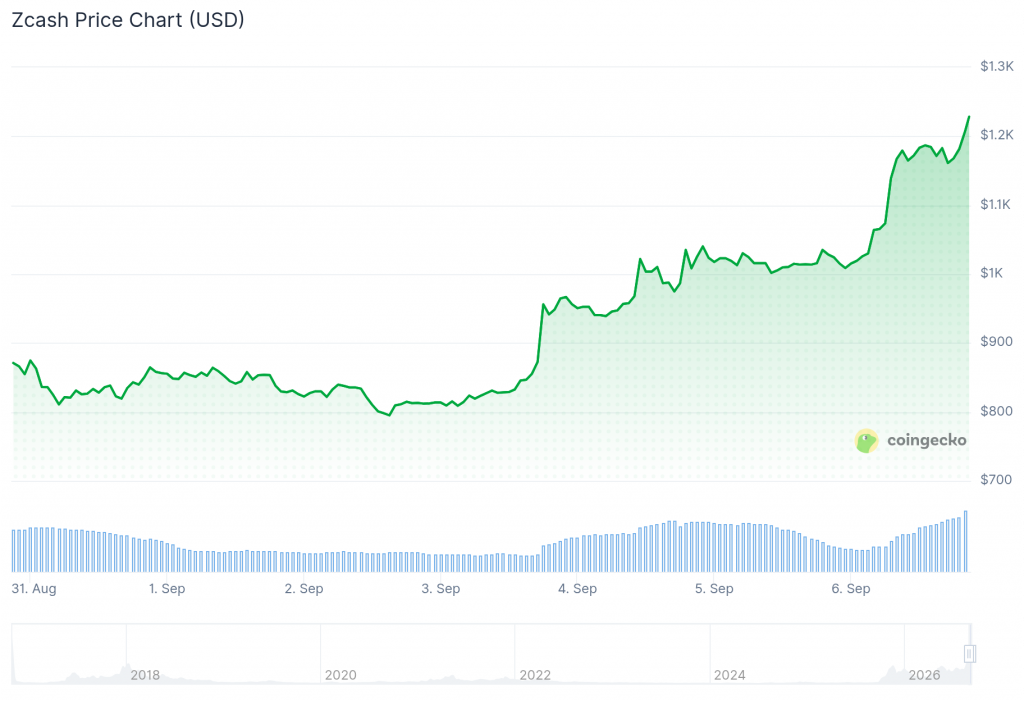
The standout large-cap move came from Zcash (ZEC), which rose from a Aug. 31 close of $847.71 to over $1,200 at press time on Sunday, putting it up roughly 36% over the past seven days. The asset’s market capitalization climbed to about $20.5 billion. while daily trading volume exceeded $1.6 billion.
More importantly, the move marked a major historical milestone for Zcash: ZEC reclaimed the $1,000 level for the first time in nearly a decade, breaking decisively above a price threshold it had not sustained since the cryptocurrency’s early years. The move was accompanied by a surge in ZEC’s value relative to Bitcoin, with the ZEC/BTC exchange rate spiking above 0.015 BTC on Sunday,.
Several factors have converged behind the rally. Grayscale’s ZCSH spot Zcash ETF, which launched Aug. 25, has provided institutional investors with a regulated route into the privacy-coin trade, while the Ironwood upgrade earlier this year addressed a shielded-pool vulnerability and restored confidence around Zcash’s supply verifiability. The break above $1,000 then appears to have accelerated momentum, with short positioning adding fuel to the move. Zcash’s performance also came alongside a broader revival in privacy-coin interest.
Why it matters: Bitcoin’s relatively modest weekly gain masked a much more aggressive rotation underneath the surface, but Zcash’s return above $1,000 is the week’s clearest signal that capital is once again willing to chase specialized crypto narratives, with privacy emerging as one of the market’s strongest themes.
Strategy returns to Bitcoin buying with $370 million purchase
Strategy resumed its Bitcoin accumulation strategy last week, purchasing 4,603 BTC for $369.7 million between Aug. 24 and Aug. 30. The company paid an average of $80,318 per coin, bringing its total holdings to 845,050 BTC, acquired for roughly $63.73 billion at an average cost of $75,412 per bitcoin. The purchase marked Strategy’s first Bitcoin acquisition in about two months, following a period in which the company had sold BTC and built up dollar liquidity.
According to a filing with the Securities and Exchange Commission (SEC), the latest purchase was funded through Strategy’s at-the-market equity program. The company raised $602.8 million from selling 4.53 million MSTR shares, allocating $369.7 million to Bitcoin, while using the remainder for preferred-stock repurchases, dividends and cash reserves. The return to buying suggests Strategy is once again willing to deploy capital into BTC even after the market’s summer rebound pushed its latest purchase price well above the levels at which it sold Bitcoin earlier in the year.
Why it matters: Strategy’s renewed buying reinforces its role as one of the largest institutional sources of structural Bitcoin demand, while the use of equity issuance highlights the increasingly financialized nature of the corporate Bitcoin-treasury model.
Strategy has acquired 4,603 BTC for $370M, increased USD Cash by $29M, and repurchased $152M of $STRC. As of 8/30/26, we hold 845,050 bitcoin:native and $6.71B of USD Assets, bringing Net Leverage to 0.0%. $MSTR https://t.co/XAAEZV5Gil
— Michael Saylor (@saylor) August 31, 2026
CLARITY Act heads toward September 15 Senate test as sheriffs drop opposition
U.S. crypto legislation moved closer to a critical Senate test this week, with SEC Chair Paul Atkins saying he expects the CLARITY Act to come before lawmakers on Sept. 15 and expressing hope that it will ultimately pass and reach President Donald Trump’s desk. The Sept. 15 vote is a procedural cloture vote rather than final passage, meaning supporters will first need 60 votes to advance the bill to full Senate consideration.
The bill also lost a significant source of opposition. The National Sheriffs’ Association said Sept. 3 that it was moving from opposition to a neutral position, telling Senate leaders John Thune and Chuck Schumer that the legislation is complex and that it would step back to allow Congress to continue working on the framework. The move does not amount to an endorsement, but removes a prominent law-enforcement objection ahead of the procedural vote.
Why it matters: The combination of regulatory backing from the SEC chair and reduced law-enforcement opposition improves the political backdrop for CLARITY, but the Sept. 15 cloture vote remains the first major hurdle and does not guarantee Senate passage.
The Regulation Crypto Assets proposal is our most historic step yet to cement America as the Crypto Capital of the World—and is consonant with our belief that Congress should send the CLARITY Act to the President’s desk. pic.twitter.com/Z9Pep2Wvph
— Paul Atkins (@SECPaulSAtkins) September 2, 2026
Payward expands its Wall Street footprint as Kraken IPO slips to 2027
Payward, the parent company of crypto exchange Kraken, is reportedly pushing back its long-anticipated initial public offering to the second quarter of 2027 at the earliest. The delay marks the second time the company has moved its listing timetable, underscoring the more cautious backdrop facing crypto markets despite renewed institutional interest in digital assets.
The IPO delay comes as Payward continues to expand Kraken’s role as infrastructure connecting traditional finance with crypto markets. On Sept. 3, Payward and SoFi announced a partnership designed to link SoFi’s banking and dollar-settlement network with Kraken’s trading infrastructure. Under the arrangement, SoFiUSD, SoFi’s bank-issued stablecoin, will be made available on Kraken, while Payward will join the SoFi Exchange Network, allowing Kraken customers to access 24/7 U.S. dollar settlement outside conventional banking hours.
The deal effectively connects a regulated banking network with one of the largest crypto trading venues, potentially reducing one of the persistent frictions between traditional financial markets and crypto: the mismatch between 24/7 digital-asset trading and the operating hours of the banking system. It also gives SoFiUSD a major distribution channel while giving Kraken customers another route for moving dollars into and out of crypto markets.
At the same time, Payward is positioning itself deeper inside traditional capital markets. This week, the company announced a partnership with London Stock Exchange (LSE) to explore tokenized public equities, with plans for tokenized versions of the 100 largest London-listed stocks to be offered as xStocks. The tokens are intended to support 24/7 trading across exchanges, self-custody wallets and onchain applications, subject to regulatory approval.
The LSE partnership is particularly notable because it puts Payward on the other side of the same bridge it is building with SoFi: rather than simply bringing crypto users into traditional financial products, it is helping bring traditional securities onto blockchain-based infrastructure. LSE plans to support xStocks through its forthcoming LSE 24 venue, while also exploring issuer-sponsored equity tokens that could more closely replicate the rights associated with conventional shares.
Taken together, the developments paint a different picture of Payward from the one implied by its delayed IPO. While the public listing is being pushed into 2027, the company is simultaneously expanding its role as financial infrastructure—connecting banks, stablecoins, crypto trading and tokenized securities.
Why it matters: Payward’s IPO may be moving further out, but its underlying strategy is moving deeper into traditional finance, positioning Kraken as infrastructure for a market in which banking, securities and crypto increasingly operate on the same rails.
Payward Pulse: Episode 4 📡
The latest from, the parent company behind Kraken.
→ UK equities go onchain with @LSEplc
→ A strategic partnership with @SoFi across banking and payments
→ Two new crypto indices from @CFBenchmarksTune in 👇 pic.twitter.com/67jl5i7fKu
— Payward (@Payward) September 4, 2026
Wall Street banks unite around a new dollar stablecoin
A coalition of 21 major financial institutions, including Goldman Sachs, Citigroup, Bank of America and Deutsche Bank, is preparing to launch a company that would issue a U.S. dollar-pegged stablecoin, with the first token targeted for early 2027. The venture will focus initially on payments and digital-asset settlement, with stablecoins linked to other G7 currencies, particularly the euro, identified as a priority for future expansion.
The project represents a notable escalation in traditional finance’s interest in stablecoins. The participating institutions are moving beyond experimenting with blockchain infrastructure toward jointly building a payments asset, potentially putting bank-issued stablecoins into direct competition with established issuers such as Tether. Adoption remains an open question, however, with existing bank stablecoins still accounting for only a tiny fraction of the market.
Why it matters: The initiative signals that stablecoins are increasingly being treated by global banks as payments infrastructure rather than simply a crypto product, potentially reshaping competition between traditional financial institutions and crypto-native issuers.
Firelight raises $8 million to build DeFi protection for fintechs
Firelight Protocol has raised an $8 million seed round led by Gumi Cryptos Capital, with participation from Maven 11, Metalayer, Joint Effects and Tribe Capital, to develop decentralized protection against protocol, smart-contract and economic risks. The project was incubated by institutional DeFi provider Sentora and is designed to give fintechs and other financial platforms a mechanism for recovering losses associated with onchain exploits.
Firelight initially uses XRP as the capital base for its protection pools and plans to expand to Bitcoin and XLM. Its model effectively separates the capital backing DeFi protection from the assets and protocols being insured, while allowing holders of those assets to earn yield by providing protection capital. The company says its first cover integrations are scheduled to go live in September, targeting a growing gap between institutional DeFi adoption and the limited amount of onchain capital currently protected against losses.
“Protocol cover and capital protection remain among the biggest blockers to institutional adoption of DeFi,” said Anthony DeMartino, co-founder and CEO of Firelight. “Institutions need confidence that they can deploy capital onchain with credible protection against smart contract and economic risk.
Why it matters: As DeFi moves further into fintech and institutional markets, insurance and risk-transfer infrastructure could become as important to adoption as custody, compliance and liquidity.
Trezor breach widens to expose data of 67,000 more U.S. customers
Hardware wallet maker Trezor disclosed this week that a data breach at its shipping provider, ShipMonk, was significantly larger than initially reported, exposing the personal information of another 67,000 U.S. customers. The newly identified records relate to orders placed between November 2019 and August 2021 and include customers’ full names, email addresses, phone numbers, shipping addresses and order numbers. The latest disclosure brings the total number of affected customers to more than 80,000.
The revelation is particularly concerning because Trezor said ShipMonk had previously provided written assurances that the older customer data had been deleted in accordance with its contractual obligations. Trezor stressed that its own systems, hardware wallets, private keys and recovery seeds were not compromised, but the exposure of names and physical addresses creates an obvious security and phishing risk for people known to own cryptocurrency hardware.
Why it matters: The incident highlights a persistent security problem for self-custody users: protecting private keys is only part of the threat model when third-party vendors can expose the identity and physical location of people known to hold crypto.