

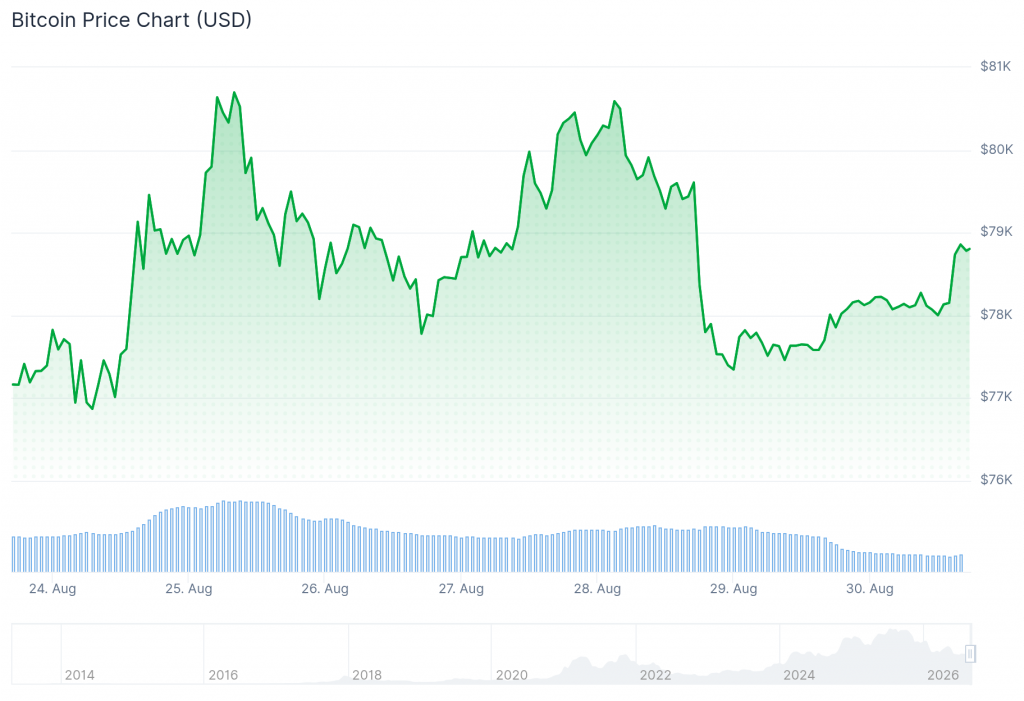
This week was more of a consolidation phase, with Bitcoin holding near the $80,000 mark after last week’s sharp recovery and briefly climbing above $81,000, the level for the first time since May.
BTC entered the week around $77,000 and pushed above $80,000 on Tuesday, eventually reaching a weekly high of roughly $81,400–$81,500 before momentum stalled. Bitcoin was trading between $78,000 – $79,000 by press time on Sunday, leaving it below the week’s peak but still substantially above the levels seen earlier in August.
The move was accompanied by a dramatic revival in market activity. Crypto exchange volumes doubled in just five days to more than $37 billion, although they remained well below the year’s $105 billion peak. The Block also noted that Bitcoin and Ethereum had gained more than 23% and 30%, respectively, in the preceding week, underscoring the scale of the rebound.
Sentiment flipped just as quickly. The Crypto Fear and Greed Index reached 81, or “extreme greed,” on August 24–25, its first reading in that territory since late 2024. The turnaround was particularly striking given that the index had been at 36 a month earlier and 41 only a week before.
Several factors helped fuel the rally. Markets continued to digest the U.S. Treasury’s last week’s decision to double its purchases of longer-dated government bonds, a move that pressured the dollar and revived the so-called “debasement trade” benefiting both gold and Bitcoin. CryptoQuant subsequently said Bitcoin had entered the early phase of a new bull market, although it stopped short of declaring the trend officially confirmed: BTC would need to decisively close above its 365-day moving average, around $83,000, to meet the firm’s historical bull-market signal. At the same time, CryptoQuant Head of Research Julio Moreno warned that the market was becoming overheated, with rising exchange inflows and profit-taking from traders and whales.
Market regime has switched to Bull for Bitcoin.
Basically all metrics are pointing to the initial phase of a new bull market.
Two things to keep in mind:
– Bitcoin’s price still has to cross above its 365-day MA ($83K today) for the bull market to be “officially” confirmed.… pic.twitter.com/Vw0hZWHRvX— Julio Moreno (@jjcmoreno) August 25, 2026
The rally faced its first serious test toward the end of the week. Bitcoin’s move toward $81,500 was followed by a retreat below $79,000 as traders prepared for $6.4 billion worth of Bitcoin options to expire on Deribit. Roughly 81,700 contracts expired on August 28, clearing a large amount of positioning that had been established before Bitcoin’s rapid ascent.
The bigger macro test came later the same day from Federal Reserve Chair Kevin Warsh’s Jackson Hole speech. Traders had been looking for clues about the Fed’s next move, but Warsh deliberately avoided providing forward guidance and instead emphasized the Fed’s focus on persistent inflation. Bitcoin briefly sold off by around $2,000 following his remarks before recovering, while the market continued to price considerable uncertainty around the September rate decision.
Institutional flows also provided the first warning that the rally could be losing some momentum. After nine consecutive sessions of inflows totaling roughly $3.04 billion, U.S. spot Bitcoin ETFs recorded a $202 million net outflow on August 28. Ethereum ETFs moved in the opposite direction, attracting approximately $102 million that day.
By the weekend Bitcoin’s picture had become more nuanced. The move from the low-$60,000s toward $80,000 represented a powerful reversal, with improving spot demand, rising volumes and dramatically stronger sentiment all supporting the bullish case. But $80,000–$83,000 has emerged as a crucial resistance zone. Failure to break and hold above it, combined with fading ETF inflows and a still-hawkish inflation backdrop, leaves Bitcoin vulnerable to a consolidation or deeper correction before the next attempt higher. CryptoQuant’s $83,000 threshold may consequently become the market’s key technical marker heading into September.