
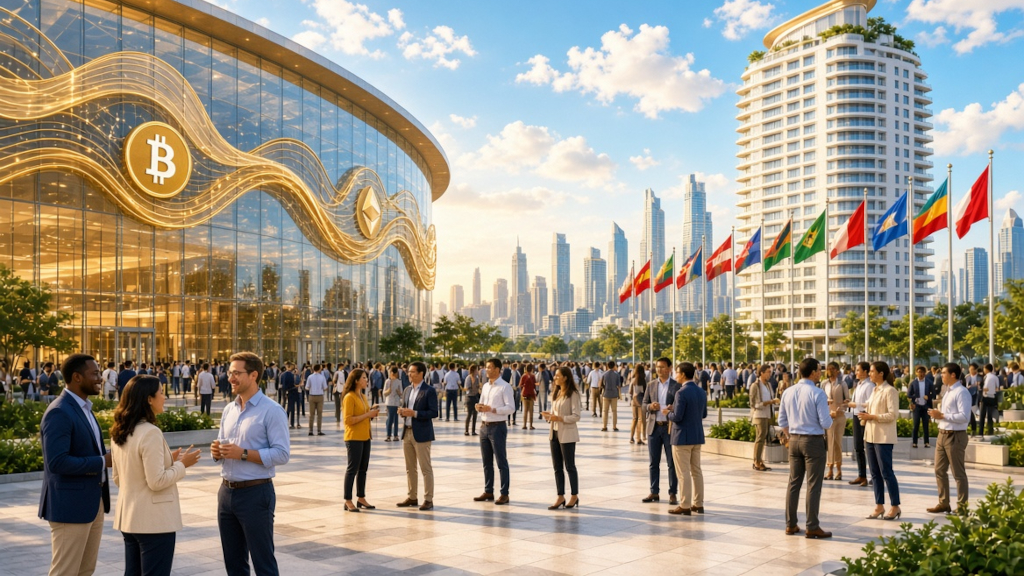
Crypto events are how this industry actually gets business done. Funding rounds start in hallway conversations, listings get agreed over dinner, and partnerships that took months of email close in twenty minutes at a side event. There are more of these on the calendar every year than anyone could attend, but the same handful have stayed at the top of the list edition after edition.
And when you’ve picked one, you can book the hotel the same way you’d pay for anything else in this industry: in crypto. trip1.com lists the major crypto events alongside the hotels near each venue, and lets you pay for the stay in Bitcoin, Ethereum, USDC, BNB, Litecoin or another stablecoin – no card, no bank in the middle, no foreign-transaction fee for flying to a conference about removing intermediaries.
What counts as a crypto event
The term covers four fairly different things, and knowing which you’re walking into matters more than the ticket price.
Industry conferences are the big ones. Large expo floors, a mainstage, and a business-development culture that runs on scheduled meetings.
Developer conferences are technical. Protocol research, client teams, EIP authors. Less dealmaking, more actual building.
Regional gatherings connect the global industry to a specific local market. If you’re expanding into Asia or the EU, these are worth more than a generic global event.
Side events aren’t on any official schedule, and are where much of the value is. Dinners, yacht parties, protocol activations, investor breakfasts. At the largest conferences there are hundreds of them running in parallel, and plenty of attendees never set foot in the main venue.
The most popular crypto events
TOKEN2049 – Singapore and Dubai. The networking apex of the crypto calendar. Founders, funds, exchanges and institutions in one place, and a surrounding “week” that takes over the host city with hundreds of unofficial side events. It sells out most years.
Consensus – the CoinDesk flagship, historically in the US with an APAC edition. Broad, industry-wide, and heavy on policy and capital markets. The most media-dense event of the year.
The Bitcoin Conference – the largest bitcoin-specific gathering in the world, recently anchored in Nashville. Bitcoin-only in focus, with a mix of maximalist culture, mining, and increasingly institutional attendance.
Devcon / Devconnect – the Ethereum Foundation’s flagship developer events. Protocol research, scaling, privacy, governance. Where Ethereum is actually built rather than sold.
Korea Blockchain Week – Seoul. The best route into the Korean and wider Asian market. Rather than an international conference that happens to be in Asia, it gives access to local exchanges, local capital and local media.
Bitcoin Asia – Hong Kong. The Asian counterpart to the US bitcoin circuit, and the main gathering point for the region’s bitcoin investors and builders.
European Blockchain Convention – Barcelona. The main EU-facing event, weighted toward regulation, institutional adoption and the European funding scene.
Solana Breakpoint – a different city each year. The Solana ecosystem’s annual gathering, and the clearest snapshot of where that chain’s development is heading.
Blockchain Life – Dubai and Moscow editions. Skews toward trading, mining and exchanges, with a large expo floor and a strong emerging-markets attendance.
Singapore FinTech Festival – where crypto rails meet banks, regulators and payments incumbents. Stablecoin infrastructure has become a dominant theme.
Web Summit – Lisbon. Not crypto-native, but the biggest mainstream-tech crossover on the calendar, with dedicated crypto programming and a very large Web3 contingent.
EthCC – Europe’s long-running Ethereum community conference, with a developer-heavy audience and a side-event ecosystem that rivals the main programme.
How to plan a crypto event trip
Book accommodation before tickets. Conference weeks are peak-pricing weeks in the host city, and the properties near the venue go first. At most of these events the hotel ends up costing more than the pass.
Give yourself a couple of months of lead time. Rates within walking distance of the venue climb steeply in the final weeks. For events with a fixed annual slot, book as soon as the venue is confirmed.
Stay central, not next to the venue. Since the side-event circuit is scattered across the city, a central hotel usually beats one attached to the conference hall.
Get free cancellation. Crypto event plans change constantly – sponsor deals fall through, dates shift, whole editions get moved to another year. The premium on a flexible rate is cheap insurance.
Paying for it in crypto
Two practical notes on booking a conference hotel with crypto.
Pay in a stablecoin where you can. The amount you send matches the amount you were quoted, so there’s no exchange-rate drift between booking and check-in. Paying in BTC or ETH works identically at checkout – you’re just spending a volatile asset on a hotel room.
The other advantage is that nothing gets flagged. A card issued in one country and used at a hotel in Dubai or Singapore during a conference week is a classic fraud-model trigger, and there’s no worse time for a declined payment than the night before the week starts.
Crypto events FAQ
What are the biggest crypto events in the world? By attendance and dealmaking density: TOKEN2049, Consensus, the Bitcoin Conference, Korea Blockchain Week and Blockchain Life, with Devcon and EthCC covering the developer side. Web Summit is the largest mainstream-tech event with a serious crypto presence.
How much do crypto event tickets cost? Anywhere from free for community meetups to well over a thousand dollars for premium passes at the top-tier conferences, and pricing at the biggest events has trended upward year over year. Remember that the hotel during a conference week often costs more than the ticket.
When should I book a hotel for a crypto conference? A couple of months out for the major events. Hotels near the venue sell out first, and rates across the surrounding area rise steeply in the final weeks.
Are the side events more valuable than the conference itself? Often, yes. A large share of attendees at the biggest events work the side-event circuit – parties, dinners, panels and investor breakfasts – without spending much time in the main hall. The official ticket is still what gets you the venue, the app and the attendee directory, which is what makes the side events findable in the first place.
Which crypto event should I go to if I can only pick one? For general networking and fundraising, TOKEN2049. For building and protocol work, Devcon or EthCC. For breaking into Asia, Korea Blockchain Week. For Europe and regulation, European Blockchain Convention. For bitcoin specifically, the Bitcoin Conference or Bitcoin Asia.
Can I pay for a hotel with crypto when attending? Yes. trip1 lets you book hotels near the venue and pay in Bitcoin, Ethereum, USDC, BNB, Litecoin or another supported stablecoin.
Which coin should I pay with? A stablecoin like USDC is the practical choice, since the value you send matches the price quoted. Paying in BTC or ETH works the same way mechanically; you’re just spending a volatile asset on a hotel room.
Are crypto events worth attending if I’m not in the industry? The largest ones have broadened into general fintech and tech gatherings, so yes if you work anywhere tech-adjacent. If you’re purely a retail investor, expect the return to be social rather than financial.
Do crypto events get cancelled or moved? Sometimes. Editions get postponed, relocated or folded into a sister event, occasionally at short notice and usually for regulatory or regional reasons. It’s a good argument for refundable hotel rates.
Where can I find a full list of upcoming crypto events? The trip1 events calendar lists dates, cities and nearby stays for each event in one place, so you can plan the trip and the booking together.