
OpenClaw is an innovative open-source framework for developing autonomous AI agents, created by Austrian software engineer Peter Steinberger in November 2025. Originally dubbed Clawdbot, OpenClaw emerged from a rapid prototyping session that captivated the tech community, quickly evolving into the fastest-growing repository in GitHub history, amassing over 175,000 stars. The platform aims to empower users by allowing them to create adaptable AI assistants (otherwise known as AI Agents) that operate on local machines or servers, promoting flexibility while raising concerns about security and governance in AI technologies.
Origins and Development
OpenClaw, initially conceived as Clawdbot, emerged from the imaginative mind of Austrian developer Peter Steinberger in November 2025. Its creation was marked by rapid prototyping and creative innovation, famously resulting from a one-hour development session that captured the attention of the tech community. The prototype quickly evolved, and OpenClaw gained notoriety for becoming the fastest-growing repository in GitHub history, amassing over 175,000 stars due to its open-source nature and developer-friendly features.
The project originally aimed to address limitations in creating adaptable AI assistants. It was designed to run on local machines or servers, allowing users to modify its code with minimal oversight, which provided both flexibility and risk management challenges.
As the project gained traction, it underwent several name changes, reflecting community feedback and trademark considerations, ultimately settling on OpenClaw as its permanent identity.
Adoption and Challenges
OpenClaw’s transition from a niche project to widespread adoption highlighted both its appeal and the potential risks associated with its use. The rapid growth of OpenClaw led to increased scrutiny regarding security and governance, as the framework allowed technical users to experiment with autonomous AI capabilities that could inadvertently lead to misuse or unintended consequences.
The early months of 2026 marked a pivotal period for OpenClaw, characterized by both explosive growth and security incidents that raised alarms among users and developers alike. As OpenClaw’s visibility on platforms like GitHub surged, it also faced challenges related to exposed instances and malicious skills that were discovered, prompting discussions about enhancing the security model. Notably, the project experienced a surge in stars and community engagement during this tumultuous period, reflecting the dual nature of its narrative—a blend of innovation and risk.
OpenClaw Technical Features
OpenClaw is designed as a robust tool-execution environment that emphasizes system stability, security, and the capability to run various tasks, including Shell and file operations. Its architecture leverages a combination of advanced features that set it apart from other digital assistants, such as ChatGPT, particularly in terms of user autonomy and risk management
Core Architecture
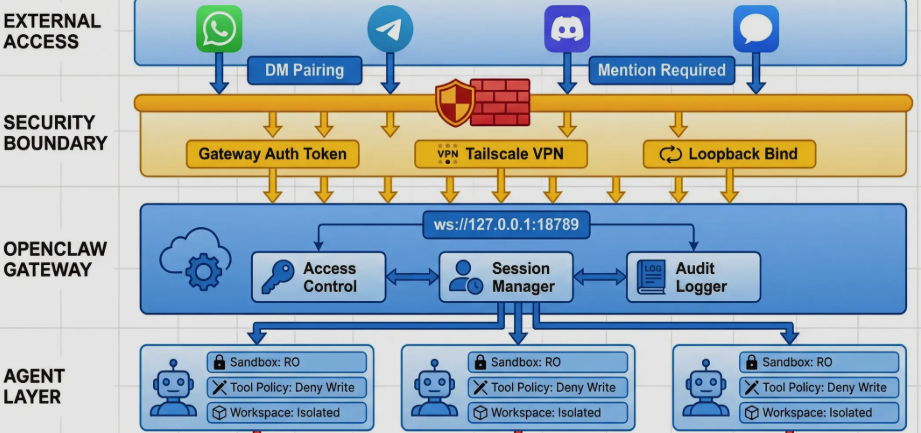
The core insight behind OpenClaw’s architecture lies in its ability to seamlessly integrate various components, including a large language model (LLM) connection and concurrent execution capabilities. This structure allows for high-performance processing while maintaining a focus on systemic engineering aspects such as security and observability.
User Engagement and Personalization
OpenClaw’s user experience is designed to be transformative, integrating with common messaging applications to enhance accessibility. It offers persistent memory for deep personalization and employs local data handling, which contributes to user confidence in data privacy and control. Users can leverage OpenClaw for a range of tasks—from automating debugging processes to managing smart home devices—further highlighting its versatility.
Security Considerations
Despite its innovative features, OpenClaw presents significant security challenges. For instance, many of its functionalities require extensive permissions that may lead to vulnerabilities if not properly managed. Skills within OpenClaw can request high-level access to sensitive information, such as emails and financial data, without necessitating explicit user approval for each action. This poses risks including unintended actions and potential data exfiltration.
Development and Customization
OpenClaw is open-source and allows developers to customize the framework extensively. This makes it particularly appealing to technical users and hobbyists who seek to tailor the assistant to their specific workflows. Developers can create and share skills, enhancing OpenClaw’s ecosystem while also introducing potential risks associated with unvetted code and high-value credentials.
Integration with Existing Systems
OpenClaw’s ability to connect with various services across a user’s digital ecosystem—including data storage and banking applications—highlights its ambition to serve as a central hub for personal and professional automation. This capability is crucial for performing complex and high-stakes tasks, establishing OpenClaw as a significant tool in the AI assistant landscape.
Applications of OpenClaw
OpenClaw serves as a versatile tool-execution environment, enabling users to harness its capabilities for a range of applications, from personal AI assistance to automated workflows.
Custom Workflow Automation
One of the most significant applications of OpenClaw is its ability to facilitate custom workflow automation through skill extensions. Users can build specific skills that automate repetitive tasks such as data collection, reporting, and system integrations. This programmability allows users to embed domain-specific logic tailored to their internal processes, leading to highly customized automation solutions. For example, technical users can create skills that fetch structured data from APIs, process the data locally, and relay summarized results via messaging platforms. Additionally, users can chain together operations like browsing, file manipulation, and script execution to design semi-autonomous workflows, which ultimately reduces the need for manual intervention.
Local-First Personal AI Assistant
OpenClaw is designed to function as a personal AI assistant that runs locally on users’ machines, distinguishing itself from cloud-based alternatives. This local-first model empowers users to maintain control over their data and execution context, thereby enhancing privacy and security. OpenClaw can interact with various messaging platforms, including WhatsApp, Telegram, Slack, and Discord, while executing tasks such as running scripts and managing files directly from the user’s device. This local setup is particularly appealing to users who prioritize data ownership and prefer an assistant that minimizes reliance on external servers.
Experimentation and Learning
For developers and AI enthusiasts, OpenClaw serves as a sandbox environment for experimenting with autonomous and semi-autonomous workflows. Builders can test their concepts for conversational automation and integrate custom skills into the assistant, making it an ideal platform for learning and exploring emerging AI agent paradigms. As users experiment with OpenClaw, they can observe how different automated processes behave in real-world scenarios, enhancing their understanding of AI applications.
Security and Control
The architecture of OpenClaw allows users to either operate it in a controlled sandbox environment or grant it full system access to execute scripts and manage files. This dual approach caters to both cautious users who prefer limited permissions and those who require extensive access for automation tasks. However, the open-source nature of OpenClaw necessitates a certain level of technical knowledge to manage potential security risks effectively, making it more suitable for technically inclined users.
Community and Ecosystem
OpenClaw has cultivated a vibrant community and ecosystem centered around the development and integration of autonomous AI agents. Launched in early 2026, the platform quickly evolved from a single-agent framework into a comprehensive ecosystem, driven by community contributions and collaborative tools such as the MoltHub. This ecosystem is characterized by community-built “skills” and “hooks” that connect lifecycle events to automations, facilitating a more extensible and adaptable user experience.
Community Contributions
The growth of OpenClaw’s ecosystem is significantly attributed to its communal skill repository, which operates similarly to the Node Package Manager (npm).
Developers are encouraged to create and share reusable skills that enhance the functionality of the platform, thereby fostering a culture of collaboration and innovation among users. As projects gain popularity, they attract not only contributors but also adversaries, creating a complex environment of rapid innovation intertwined with security challenges.
Ecosystem Impact
The OpenClaw ecosystem has seen a concentrated geographical distribution of its user base, with over 65% of the infrastructure located in the United States, China, and Singapore.

This concentration reflects the density of cloud providers and VPS platforms, which facilitate the operational needs of such a dynamic community. The framework’s ability to enable automation has drawn considerable attention, leading to significant interest from investors and prompting a re-evaluation of related AI entrepreneurship tracks.
Peter Steinberger
Peter Steinberger is an Austrian software engineer and entrepreneur, born and raised in Austria. He attended the Vienna University of Technology (TU Wien) from 2004 to 2010, where he studied medical computer science. During his time at the university, he contributed to early educational initiatives in iOS and Mac development and served as a tutor for multiple student teams, helping launch the first Mac/iOS developer course at the institution[7]
Professional Career
In 2011, Steinberger co-founded PSPDFKit (later rebranded as Nutrient), an iOS PDF framework that gained significant traction and growth over the years. The company, which started as a bootstrap initiative, expanded to a team of over 100 employees by 2022 and supported applications used by nearly 1 billion people worldwide.
His experience in San Francisco played a critical role in bridging his academic knowledge with practical innovation in mobile technologies. His pivot to AI agents started almost casually in late 2025 with a side project he initially called Clawdbot.
On February 15, 2026, Steinberger announced his decision to join OpenAI to advance the development of next-generation personal AI agents. This move came after receiving multiple offers from major tech companies, including Meta, but he ultimately chose OpenAI due to its commitment to supporting OpenClaw as an independent open-source project.
OpenAI’s CEO Sam Altman emphasized that Steinberger’s expertise would help propel the company’s ambitions in the realm of agentic AI, marking a pivotal moment in the ongoing evolution of intelligent software solutions.