

Venice AI, the privacy-focused artificial intelligence platform founded by crypto entrepreneur Erik Voorhees, has closed a $65 million Series A round at a $1 billion valuation, its first outside funding since launching in May 2024.
The round was led by crypto-focused venture firm Dragonfly, with participation from North Island Ventures, Coinbase Ventures, F-Prime, Archetype, Liquid2 Ventures, and Morgan Creek. In return for the $65 million, Series A investors received an 8.98% equity stake in Venice AI, a vesting grant of 1.5 million VVV tokens, and warrants giving them the right to purchase an additional 5 million VVV tokens over the next eight years.
Voorhees, best known as the founder of the ShapeShift cryptocurrency exchange, announced the funding on X Wednesday, positioning it as validation for Venice’s core thesis: that mainstream AI platforms like ChatGPT are built on a model of mass data collection that users should be able to opt out of.
“This aversion to ubiquitous centralized surveillance and control is our philosophical foundation, and upon it Venice is growing rapidly,” Voorhees wrote. “In April, we hit 3 million users, and as of Q1, in an environment where AI firms were losing money while spying on you, Venice became profitable while choosing not to.”
Venice says it does not retain users’ prompts on its own systems, instead keeping conversations stored on users’ own devices, and handles more than 1.7 million API calls per day. The platform offers access to over 200 AI models—both open-source models it hosts directly and closed-source models from providers like OpenAI and Anthropic, accessed anonymously via API.
In an interview with TechCrunch, Voorhees said the company has surpassed $70 million in annualized revenue and turned profitable in the first quarter of 2026 — a relatively rare milestone in an AI industry where many well-funded competitors are still burning cash at scale.
Venice raises a $65M Series A at a $1B valuation https://t.co/9njvvz0L0D
— Venice (@AskVenice) July 1, 2026
Privacy as a product, not a feature
Venice’s pitch rests on a concern that has become harder to dismiss: as AI chatbots become go-to tools for sensitive decisions—medical questions, legal advice, personal dilemmas—the data being handed over to centralized platforms accumulates quietly and indefinitely.
Talking to GeekWire, Jesse Proudman, Venice’s president and CTO, put it plainly:
“It only takes one breach, one disgruntled employee who is going through that data, a government subpoena, a change in government policy — and then all of that data no longer is private to you.”
Voorhees went further in his announcement post, arguing that the AI industry’s fixation on job displacement and cybersecurity risks misses what he sees as a more fundamental threat.
“Perhaps it is not job losses or cybersecurity incidents that should most frighten us, but rather that our flow of consciousness is increasingly under examination—our thoughts are now constructed in tandem with and at the permission of this dystopian apparatus,” he wrote.
The new capital will go toward building Venice’s own compute infrastructure. That includes its first proprietary data center, reducing the company’s reliance on leased GPUs—a move Voorhees said will “ensure capacity in the coming resource squeeze and increase gross margins, making larger VVV burns feasible.” Venice also plans to expand into new markets and make what Voorhees described as “additive” acquisitions.
Token structure raises alignment questions
Venice operates with a dual-token economy. Users can stake VVV tokens to receive staked VVV (sVVV), then lock a portion of that to mint DIEM—a credit worth $1 of AI compute access on the platform that never expires. To fund this round, Venice chose to sell equity rather than draw down its token treasury. Voorhees noted that Venice remains the largest holder of VVV, with more than 30 million tokens out of over 80 million in supply, and said neither the company nor its team has sold any tokens despite the token rising more than 700% this year.
The decision has sparked debate among token holders about whose interests the capital structure actually serves. Venice sold equity without selling VVV, leaving open the question of whether token holders and shareholders are truly aligned, or sitting in different classes of the same growth story. That’s not a trivial concern: equity investors have legal rights and governance protections that token holders generally do not.
Only about 8% of users pay with crypto, which also undercuts the idea of Venice as a primarily crypto-native platform—most of its user base engages with it as a conventional privacy-focused AI product.
Wednesday also brought the latest in a series of planned emissions cuts, reducing the rate of new VVV issuance from 4 million to 3 million tokens per year—a move designed to tighten supply as the platform scales.
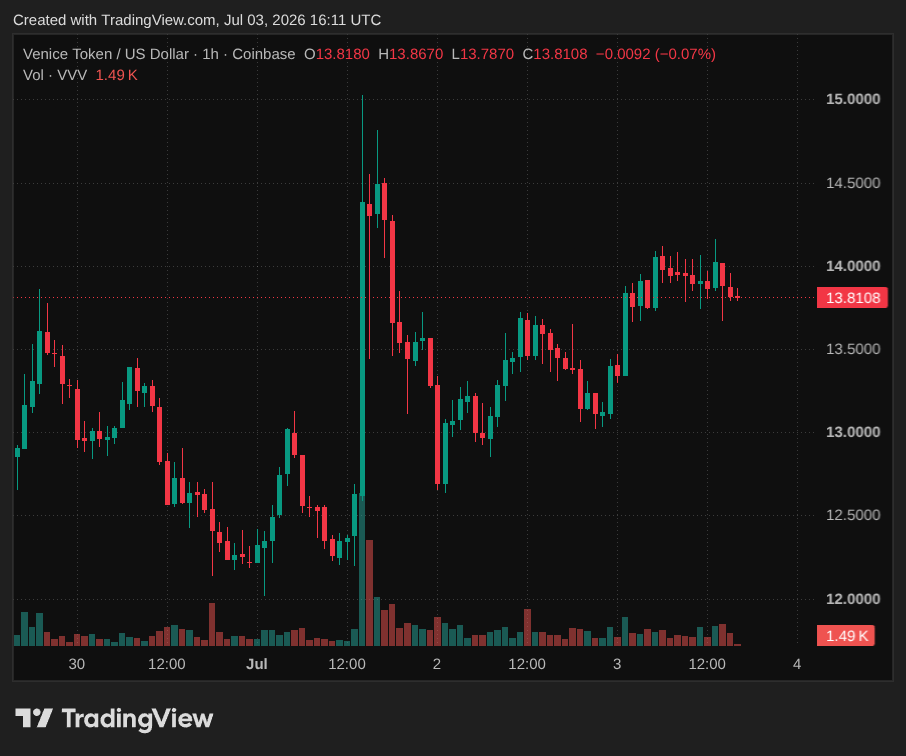
VVV spiked double-digits following the announcement and was trading at $13.81, up 2.4% over the last 24 hours.
There are other questions worth considering. Venice’s claim that it cannot see user conversations rests on technical architecture—encrypted proxies and locally stored chat history—but Voorhees himself has acknowledged the system does not provide perfect anonymity. “Substantially better” than the status quo is a meaningful bar, but it is not the same as zero-knowledge privacy, and users relying on Venice for genuinely sensitive matters should understand the distinction.
The funding arrives as AI privacy is attracting more scrutiny in Washington. Lawmakers have introduced legislation to require warrants for AI-assisted government surveillance, while the FBI has expanded its use of AI for threat analysis and facial recognition—the kind of institutional activity Voorhees is explicitly positioning Venice against.
“We will construct the platform dedicated to private and unrestricted machine intelligence; an open, permissive port city that respects the sovereignty of its inhabitants, both human and agentic,” Voorhees wrote.