
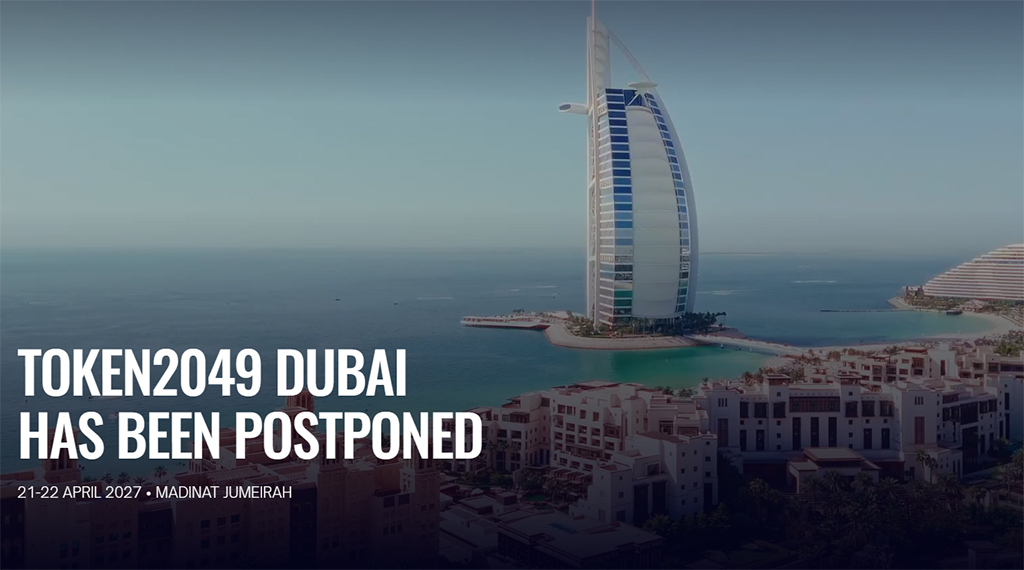
TOKEN2049 Dubai, the crypto industry’s largest annual gathering in the Gulf will not take place this spring, a direct casualty of the widening regional conflict that has disrupted travel, infrastructure, and institutional activity across the UAE.
TOKEN2049 Dubai, originally scheduled for late April 2026 and one of the most anticipated events on the digital asset calendar, has been postponed to April 21–22, 2027. The organizers cited “ongoing uncertainty in the region and its impact on safety, international travel and logistics”—language that maps closely onto the most significant military conflict to hit the Middle East in decades.
The decision, confirmed on the event’s official website on March 13, 2026, is the first major indicator of how the US-Israeli war with Iran—now entering its third week—is beginning to ripple through the crypto industry’s institutional and events infrastructure, beyond the immediate price moves already absorbed by markets.
What Happened
The announcement was posted to the TOKEN2049 website without a preceding press release or public social media campaign. Notably, the conference’s official X account had gone silent since late February—precisely when tensions in the region were cresting toward the opening of the US-Israeli joint military campaign that killed Supreme Leader Ali Khamenei and triggered a wave of Iranian retaliatory strikes across the Gulf.
Only today an update was posted, stating that “the safety and experience of our community always comes first.”
“In collaboration with our partners and stakeholders, and in light of the ongoing uncertainty in the region and its impact on safety, international travel and logistics, TOKEN2049 Dubai will be postponed to 21–22 April 2027,” reads the announcement.
The safety and experience of our community always comes first.
In collaboration with our partners and stakeholders, and in light of the ongoing uncertainty in the region and its impact on safety, international travel and logistics, TOKEN2049 Dubai will be postponed to 21–22… pic.twitter.com/Pw4k5nApQ3
— TOKEN2049 (@token2049) March 13, 2026
All registered tickets will roll forward automatically to the 2027 edition. Attendees who prefer not to wait can transfer their registration to TOKEN2049 Singapore, scheduled for October 7–8, 2026 at Marina Bay Sands — the only remaining major TOKEN2049 event on the 2026 calendar.
CryptoEvents reached out to TOKEN2049 organizers for additional comment. This article will be updated if a response is received.
The Conflict Backdrop
The decision did not occur in a vacuum. The 2026 Iran conflict was initiated by US and Israeli forces on February 28, 2026, with Operation Epic Fury opening strikes that killed Supreme Leader Ali Khamenei and triggered hundreds of retaliatory missiles and thousands of drones from Iran across the Middle East, leaving more than 2,000 people dead and hundreds of thousands of travelers stranded.
The conflict’s physical footprint extended directly into the UAE. Three Amazon Web Services data centers in the United Arab Emirates were struck and damaged by drone strikes, causing outages of web infrastructure within the Middle East and “major structural damage” to two of the facilities. The strikes created an availability zone failure across S3 storage, EC2 compute, and DynamoDB databases—the kind of infrastructure disruption that would make running a globally-distributed technology conference operationally untenable regardless of travel conditions.
A yacht was photographed sailing away from Dubai’s Jebel Ali port as smoke billowed from an Iranian strike on March 1, with the conflict having immediate impacts on global travel and trade across the region. The US State Department urged American citizens to leave the Middle East immediately in the days that followed.
Black smoke could be seen in Dubai’s financial district where witnesses reported hearing explosions on Friday morning. Authorities there said a building was hit by debris from an intercepted missile. pic.twitter.com/hVuzwkguU4
— Al Jazeera Breaking News (@AJENews) March 13, 2026
Cascading Effects: Token2049 Week and the Side Event Ecosystem
The postponement’s consequences extend well beyond the main conference itself. TOKEN2049 Dubai historically anchors what industry participants refer to as TOKEN2049 Week—a dense cluster of satellite events, investor dinners, protocol launches, side conferences, and networking gatherings that coalesce around the main event and collectively draw tens of thousands of participants.
Dozens of those events, many already confirmed with venue bookings, speaker commitments, and sponsor agreements in place, now face uncertain futures. Organizers of affiliated events must now independently determine whether to cancel, postpone alongside TOKEN2049, or pivot to alternative dates and locations. This fragmentation of the ecosystem introduces coordination risk: smaller organizers often lack the contractual leverage TOKEN2049 has with venues and travel providers, and some may face significant non-refundable losses.
TOKEN2049 Singapore 2026 remains on schedule for October, which may absorb some of the demand—but the geographic distance and logistical differences between a Gulf crypto hub and a Southeast Asian financial center mean the substitution is imperfect.
A Stage That Won’t Convene: Who Was Expected in Dubai
The scale of what has been lost becomes clearer when considering the speaker roster that had been assembled for the April event. TOKEN2049 Dubai 2026 was set to be among the most institutionally heavyweight editions of the conference in its history, featuring executives and founders from across every major segment of the digital asset ecosystem.
Pavel Durov, CEO of Telegram, whose TON blockchain has become one of the most active ecosystems in crypto, had been confirmed to appear, alongside Paolo Ardoino, CEO of Tether, the issuer of the world’s largest stablecoin by market capitalization. Jeremy Allaire, Co-Founder, Chairman and CEO of Circle, Tether’s primary rival in the dollar-pegged stablecoin market, was also on the programme, making Dubai the stage for what would have been a rare convergence of both dominant stablecoin issuers.
The institutional dimension was equally substantial. Robert Mitchnick, Global Head of Digital Assets at BlackRock, whose iShares Bitcoin ETF has become the fastest-growing ETF in history, had been scheduled to speak, as had Hunter Horsley, Co-Founder and CEO of Bitwise Asset Management. Their presence underscored how deeply the asset management mainstream had become woven into TOKEN2049’s programme.
On the exchange and infrastructure side, Richard Teng, Co-CEO of Binance, was confirmed, alongside Justin Sun, Founder of TRON. From the derivatives and trading world, Arthur Hayes, CIO of Maelstrom and co-founder of BitMEX, was set to take the stage a speaker whose macro commentary consistently moves markets.
The DeFi and protocol layer had assembled an equally prominent roster. Stani Kulechov, Founder of Aave Labs; Guy Young, Founder of Ethena; Keone Hon, Co-Founder and GM of Monad Foundation; Illia Polosukhin, Co-Founder of NEAR Protocol; Lily Liu, President of the Solana Foundation; and Joe Lubin, Founder and CEO of Consensys, had all been announced as speakers. Balaji Srinivasan, author of The Network State and one of the most widely followed macro-crypto commentators, was also scheduled to appear.
Rounding out the programme were Shayne Coplan, Founder and CEO of Polymarket, and Eric Trump, Co-Founder of World Liberty Financial—a speaker whose presence reflected the deepening entanglement between crypto and US political capital in the post-2024 cycle.
The list represents a cross-section of the industry that does not assemble in one room frequently. Whether these speakers reconvene at TOKEN2049 Singapore in October, defer to Dubai 2027, or scatter across competing events in the interim remains one of the more consequential open questions the postponement has created for the industry’s conference calendar.
Dubai’s Role in the Digital Asset Ecosystem
The deferral raises a structural question about Dubai’s near-term viability as a crypto hub. TOKEN2049 was careful to frame the postponement as a temporary measure, not a retreat.
“Dubai remains one of the most important hubs for the digital asset ecosystem,” the announcement stated. “We remain confident in the city and its continued leadership as a global center for innovation and digital assets.”
The organizers thanked Dubai’s regulators and government partners, signaling that official relationships remain intact.
That framing matters. The UAE has invested heavily in regulatory infrastructure for digital assets through the Virtual Assets Regulatory Authority and the Dubai Financial Services Authority’s crypto framework. Regulatory credibility, once established, tends to be durable—but reputational confidence among international attendees and institutional participants is more fragile, and requires consistent, visible presence to maintain momentum.
Forward Outlook
The decision is cyclical in cause but potentially structural in consequence. If the conflict in the Middle East extends through the summer—a scenario that some analysts describe as plausible given the complexity of Iranian retaliation and ongoing uncertainty over the Strait of Hormuz—the May–October window that forms the spine of Dubai’s event and business travel calendar will be largely lost for internationally-oriented crypto gatherings.
The next major marker for the industry is TOKEN2049 Singapore in October. That event now carries additional weight as the primary convening point for 2026. Whether the full breadth of institutional participation originally bound for Dubai redirects to Singapore, or whether some portion of it defers entirely to 2027, will be a meaningful signal of how durable the sector’s calendar infrastructure proves under sustained geopolitical disruption.
TOKEN2049 Dubai will return — April 21–22, 2027, the organizers have confirmed. What remains to be seen is how much of the industry’s momentum, deal flow, and institutional engagement can be preserved in the interim.
CryptoEvents is monitoring developments and will update this article with any additional comment from TOKEN2049 organizers.