

Crypto markets closed the week under pressure, with Bitcoin and major altcoins extending losses, even as longer-term signals remained mixed. A sharp market pullback coincided with one of the largest corporate Bitcoin buys in months, the year’s first major crypto IPO, regulatory momentum in Asia’s stablecoin sector, and a renewed debate over the future of decentralized social media—underscoring the growing gap between short-term price action and structural developments shaping the industry.
This week’s briefing highlights five major developments that defined the crypto landscape over the past seven days.
Bitcoin Slides Below $87,000 as Weekly Decline Extends
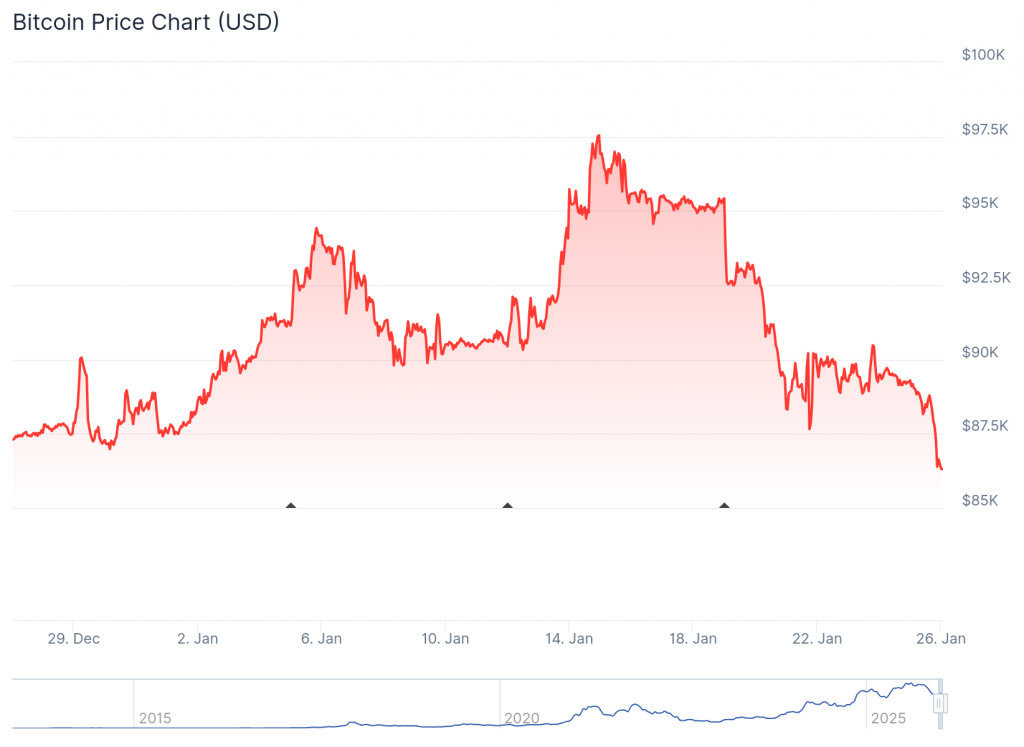
Bitcoin extended its recent downturn over the week, slipping from the low-$90,000 range on Monday to a one-month low below $87,000 on Sunday. Early in the week, BTC traded around $92,600, but weakening sentiment and continued profit-taking pressured prices downward, with intraday readings under $88,000 by week’s end. According to data from CoinGecko, Bitcoin was down 9.5% over the past week as of Sunday.
Ethereum also relinquished ground over the same period. As of late Sunday, ETH was trading near $2,800, marking a roughly 16% decline over the past seven days—a steeper pullback than most major cryptocurrencies, with the notable exception of Solana (SOL), which was trading around $118, down almost 17% over the week.
Strategy Makes Largest Bitcoin Purchase in Nine Months
Strategy, the largest corporate holder of Bitcoin, executed one of its most significant acquisitions in nearly a year on Monday, purchasing 22,300 BTC for $2.1 billion.
The transaction marked the company’s largest single Bitcoin purchase in more than nine months and followed a market pullback that saw Bitcoin decline from around $97,000 the previous week to below $92,000 by Monday, creating an opportunistic entry point for the firm.
The acquisitions mark Strategy’s largest set of weekly Bitcoin purchases since November 2024, when the firm acquired 55,500 BTC. According to the company’s purchase tracker, Strategy’s previous acquisition exceeding 22,000 BTC occurred in March 2025, though that transaction was smaller than the most recent buy.
Why This Matters
The purchase reinforces Strategy’s long-term conviction in Bitcoin as a treasury asset. The firm now holds 709,715 BTC, worth roughly $64.5 billion, acquired at an average price of $75,979 per coin for a total cost of about $53.9 billion. Accumulation of this scale during market pullbacks highlights sustained institutional demand and may influence broader corporate and investor sentiment toward Bitcoin.
Strategy has acquired 22,305 BTC for ~$2.13 billion at ~$95,284 per bitcoin. As of 1/19/2026, we hodl 709,715 $BTC acquired for ~$53.92 billion at ~$75,979 per bitcoin. $MSTR $STRC $STRK $STRF $STRD $STRE https://t.co/6hpAeOxp2I
— Strategy (@Strategy) January 20, 2026
BitGo Makes First Crypto IPO Debut of the Year
BitGo Holdings (BTGO) marked a significant milestone for the crypto industry with its successful initial public offering on January 22, becoming the first major digital asset company to list on a U.S. exchange in 2026.
BitGo signaled its IPO ambitions in July, submitting a confidential filing to the SEC following the public market debut of USDC issuer Circle. The company provides stablecoin infrastructure, token management, trading, staking, and custody services, and oversees more than $104 billion in assets, according to its website.
First trade of $BTGO 📊 featuring @mikebelshe. pic.twitter.com/2ZK98O2wxc
— BitGo (@BitGo) January 22, 2026
The crypto custody firm priced its IPO at $18 per share, above its marketed range of $15 to $17, raising $212.8 million through the sale of 11.8 million shares. BitGo shares opened at $22.43 on the New York Stock Exchange, a 24.6% jump from the offer price, valuing the company at approximately $2.59 billion.
The stock reached an intraday high near $24 before retreating to around $20 by the close of trading. The celebratory drone show over New York quickly gave way to selling pressure, with shares ending Friday at $14.50, well below the IPO price.
Why This Matters
BitGo’s IPO represents another step in the integration of digital assets into traditional finance and may serve as a bellwether for other crypto firms considering public listings. Grayscale, Kraken, and Ledger are among the companies widely viewed as near-term IPO candidates.

Hong Kong to Issue First Stablecoin Licenses in Q1
Hong Kong’s financial authorities plan to issue the city’s first batch of stablecoin issuer licenses in the first quarter of 2026, advancing its digital asset regulatory framework. The move follows the stablecoin licensing regime that came into force in August 2025, requiring strict standards for reserve backing, redemption rights, client fund segregation, and anti-money-laundering compliance.
The licensing process is overseen by the Hong Kong Monetary Authority, which has received dozens of applications from consortia involving financial institutions and technology firms. Officials have indicated that only a limited number of licenses will be granted initially.
Why This Matters
Hong Kong’s stablecoin framework positions the city as a leading global hub for regulated digital money. Clear rules could accelerate institutional adoption, support stablecoin use in payments and capital markets, and strengthen Hong Kong’s role as a bridge between traditional finance and digital asset innovation in Asia.
Buterin Signals Shift Back to Decentralized Social Media as Farcaster and Lens Change Hands
Vitalik Buterin said he plans to move fully back to decentralized social media platforms in 2026 as major shifts reshape the sector. In a post on X, the Ethereum co-founder criticized centralized platforms as “a single global info warzone” and called for competition in how online discourse is structured.
“We need mass communication tools that serve the user’s long-term interest, not maximize short-term engagement,” Buterin wrote, arguing that decentralization is key to enabling such competition.
He emphasized shared data layers that allow multiple clients to be built on top of the same protocol as a core design principle.
In 2026, I plan to be fully back to decentralized social.
If we want a better society, we need better mass communication tools. We need mass communication tools that surface the best information and arguments and help people find points of agreement. We need mass communication… https://t.co/ye249HsojJ
— vitalik.eth (@VitalikButerin) January 21, 2026
His comments came as Lens Protocol announced that Mask Network would take over stewardship, while Farcaster announced the transfer of its protocol contracts, codebase, consumer app, and token launchpad to Neynar.
Farcaster raised $150 million at a $1 billion valuation less than two years ago but later acknowledged challenges in sustaining a social-first strategy and announced a pivot toward wallet development.
Why This Matters
The leadership transitions at Lens and Farcaster, combined with Buterin’s remarks, signal a turning point for decentralized social media. As early growth models are reassessed, the focus is shifting toward sustainable protocol design, open data, client competition, and user control—key factors in determining whether decentralized social platforms can scale beyond niche communities.