
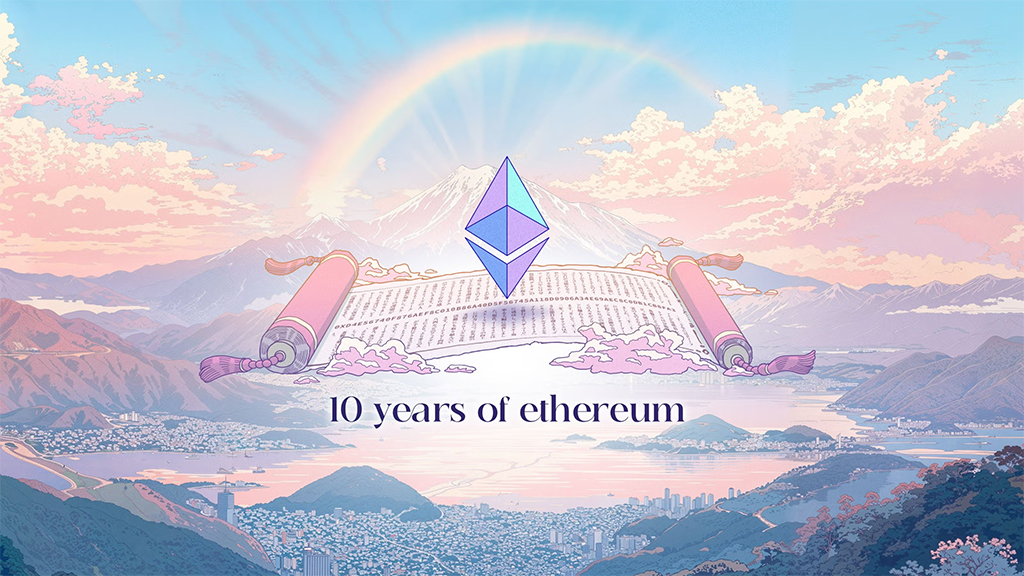
On July 30, 2015, Ethereum’s genesis block was mined—launching a radically new chapter in modern technology. What began as a visionary white paper by Vitalik Buterin in late 2013 quickly evolved into a global computing platform built on decentralization, transparency, and code-based trust.
The Origins: From Vision to Code
Ethereum was first introduced to the public in early 2014, when Buterin presented his concept at the North American Bitcoin Conference in Miami. His idea—a blockchain capable of running arbitrary code, known as a Turing-complete platform—was revolutionary at the time. Soon after, Ethereum’s development was accelerated through a public crowdsale held from July to September 2014, which raised over $18 million in ETH. That funding laid the groundwork for several client implementations, including Geth, PyEthereum, and C++ versions, each playing a critical role in preparing for launch.
On July 30, 2015, Ethereum officially went live with its Frontier release. The network began by minting 5 ETH per block and processing nearly 9,000 transactions within the first day—an early indicator of the activity and experimentation that would follow.
Crisis, Forks & the Path Forward
One of Ethereum’s most defining moments came in 2016, with the creation of The DAO—a decentralized autonomous organization that quickly became the largest crowdfunding project in history, amassing nearly 14% of all ETH in circulation. However, a critical vulnerability in its smart contract was exploited, leading to a loss of 3.6 million ETH, valued at roughly $50 million at the time.
The community was thrust into a major debate: should the chain roll back to recover funds or uphold the principle of immutability? The resolution was a contentious hard fork, splitting Ethereum into two separate chains. The new chain retained the Ethereum name and reversed the theft, while the original chain became Ethereum Classic, preserving the untampered history.
Evolution Through Upgrades
Ethereum’s adaptability has been proven time and again through a series of transformative upgrades. The Byzantium fork in October 2017 introduced enhanced privacy via zk‑SNARKs and improved gas efficiency—setting the stage for scalability efforts. The London Upgrade in 2021, marked by EIP‑1559, revolutionized Ethereum’s economic model by introducing a base-fee burn that helped stabilize transaction costs while adding a deflationary mechanism to the protocol.
The pivotal transition came with The Merge in September 2022, when Ethereum shifted its consensus mechanism from proof-of-work to proof-of-stake. This move cut energy consumption by over 99% and unlocked new possibilities in staking and network flexibility.
Building upon this foundation, the Dencun upgrade in March 2024 implemented EIP‑4844—or proto‑danksharding—reducing the cost of posting rollup data on-chain and dramatically advancing the efficiency of Layer 2 scaling.
Finally, the Pectra upgrade, launched in May 2025, combined execution-layer and consensus-layer improvements into the largest update since The Merge. It encompassed 11 EIPs—including EIP‑7251, which expanded the validator staking cap to 2,048 ETH, and EIP‑7702, which introduced smart-contract-like capabilities for user wallets, enabling seamless transaction bundling, gas sponsorship, and recovery options—all without forcing users to leave standard externally owned accounts.
Ethereum’s Cultural Explosion
Beyond its technical upgrades, Ethereum’s influence on culture and digital identity has been just as profound. The release of CryptoKitties in 2017 famously congested the Ethereum network, demonstrating both the demand for playful blockchain experiences and the urgent need for scalability. This digital collectibles game helped popularize the emerging world of NFTs, eventually leading to the widespread adoption of the ERC-721 standard.
By 2018, Ethereum had become the go-to platform for decentralized finance (DeFi), spawning a new ecosystem of applications that enabled peer-to-peer lending, algorithmic stablecoins, decentralized exchanges, and yield farming. It also served as the foundation for DAOs, reimagining how communities make decisions and allocate resources—all without intermediaries.
A Global Ecosystem
Today, Ethereum stands as a truly global platform. It processes over 24 million daily transactions and operates in more than 80 countries, with an infrastructure supported by 870,000+ validators and 13,600+ physical nodes. This vast decentralized network ensures security, censorship resistance, and global accessibility. Even more impressive, Ethereum has maintained 100% uptime across its entire 10-year history—an extraordinary feat of technical reliability and coordination.
Celebrating 10 Years: Global Events & Community
The 10th anniversary of Ethereum is being commemorated not just online, but around the world. A global livestream will take place on July 30, 2025, at 14:30 UTC, featuring key figures from the Ethereum community. Attendees will hear from Vitalik Buterin, Tim Beiko, Joseph Lubin, and Ethereum Foundation leaders Tomasz Stańczak and Hsiao‑wei Wang, among many others.
Dozens of cities—including Accra, Cape Town, Berlin, Singapore, London, and New York—are hosting meetups and viewing parties, reflecting Ethereum’s truly decentralized and grassroots culture. In addition, a symbolic NFT known as the “Ethereum Torch” is being passed from contributor to contributor over 10 days, before being ceremonially burned—a powerful gesture of shared responsibility and global unity.
Looking Ahead
As Ethereum enters its second decade, the protocol’s priorities have never been clearer. Scalability remains top of mind, with Layer 2 rollups and data sharding improving both speed and cost-efficiency. The shift to proof-of-stake—achieved through the Merge—has already reduced Ethereum’s energy consumption by over 99%, while slashing ETH issuance by around 90%, making it both more sustainable and economically sound.
Future upgrades will focus on improving user experience through intuitive interfaces, broader interoperability with other blockchains, and increased financial accessibility. Ethereum’s mission remains the same: to be the foundational layer for a more open, secure, and programmable internet.