
Zcash (ZEC) jumped more than 20% on Thursday after holders of the privacy-focused coin overwhelmingly backed reducing block times to 25 seconds while preserving the network’s existing halving schedule in a governance poll.
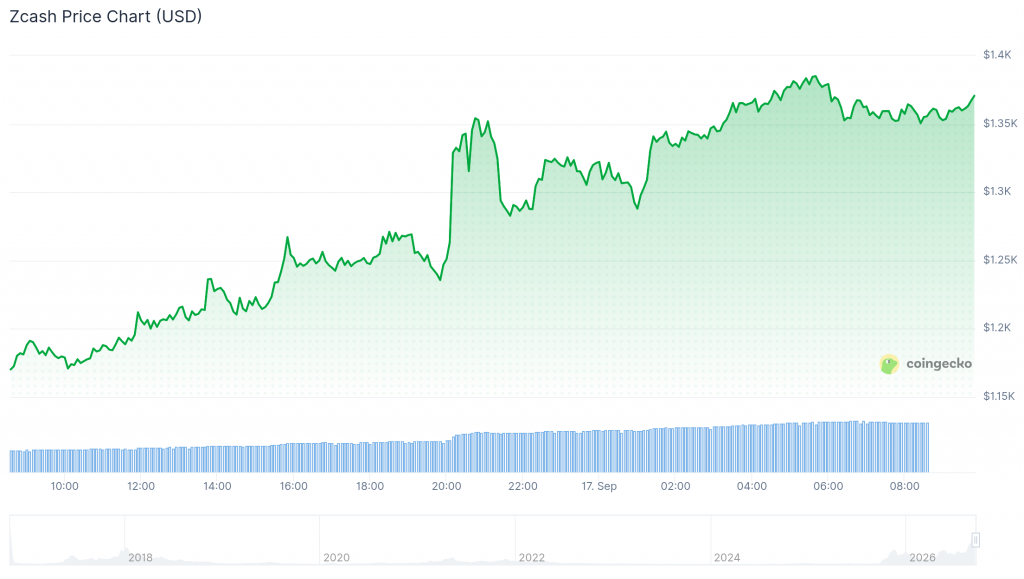
ZEC rallied from about $1,110 at the start of Wednesday to an intraday highof $1,385, according to data from CoinGecko, before slipping to $1,370 at press time. The move came a day after the results of the NU7 poll were published.
NU7, short for Network Upgrade 7, is Zcash’s next major protocol upgrade, bringing a package of changes aimed at improving the network’s performance, privacy and long-term economics. The upgrade includes a proposed reduction in block times from 75 to 25 seconds, changes to shielded transaction handling and other technical improvements, while also addressing how ZEC collected through the Network Sustainability Mechanism will eventually be recycled into block rewards.
Nearly 2.4 million ZEC participated in the vote, compared with about 3.6 million ZEC held in the eligible pool at the snapshot, representing roughly 66% participation. The process had a minimum 1 million ZEC participation threshold for the results to be considered representative.
The vote was conducted on a dedicated chain using shielded ZEC, meaning eligible holders could participate without publicly exposing the balance behind their votes.
Holders back faster blocks, Halvings remain
The strongest result was for reducing Zcash’s target block interval from 75 seconds to 25 seconds.
About 99.9% of participating ZEC backed the change, which would allow the network to produce blocks three times more frequently. Shorter block intervals can reduce the time users wait for an on-chain confirmation, although they do not by themselves determine the speed of creating a transaction.
The poll participants also rejected a proposal to replace Zcash’s existing halving schedule with a smoother issuance curve, with as many as 98.9% of participating ZEC backed preserving the current halving model. Under the proposal, ZEC removed from circulation through the Network Sustainability Mechanism would eventually be recycled into future block rewards without changing the cryptocurrency’s 21 million maximum supply.
The Network Sustainability Mechanism removes a portion of ZEC from circulation, including at least 60% of transaction fees, with those funds potentially returning to miners through future block rewards.
The vote on when to begin that recycling produced a much different result. About 96.6% of participating ZEC backed waiting until February 2031 before beginning to reissue ZEC accumulated through the mechanism.
The result comes as developers work on several other performance improvements. In August, the Zakura team released a new cryptography stack that it says can reduce the time a wallet spends creating a transaction from more than three seconds to under 200 milliseconds. Zcash developers have also been working on broader scaling initiatives aimed at increasing the network’s capacity for shielded transactions.
A private voting system
The NU7 poll was conducted using a new voting system designed to prevent the disclosure of individual voting balances.
Eligible voters needed spendable shielded funds in the Ironwood pool at the August 24 snapshot. Unlike a conventional token vote, where a wallet’s voting power can reveal how many tokens it controls, the Zcash system uses homomorphic encryption to conceal individual balances while allowing the aggregate result to be calculated.
Each vote was also split into 16 unlinkable ballots. A distributed group of validators holds separate decryption-key shares, with the final tally recoverable only when the required threshold of validators cooperates.
The system was introduced after earlier Zcash token-holder polling exposed significant differences between coinholder sentiment and the views collected from the Zcash Community Advisory Panel, or ZCAP.
The February poll, for example, drew participation equivalent to only 7.25% of circulating ZEC, according to figures cited by the Zcash community.
NU7 still needs implementation
The coinholder poll provides a strong signal for the direction of NU7, but it does not itself modify Zcash’s consensus rules.
Coinholders also voted overwhelmingly to ship NU7 with features that are ready by the September 30 deadline rather than delay the upgrade until every proposed component is complete. About 99.3% backed that approach.
The final implementation will therefore depend on developers and the organizations involved in the upgrade process translating the poll results into the appropriate code and upgrade specifications.
For now, the vote gives NU7 a clear set of coinholder preferences: faster 25-second blocks, preservation of the existing halving schedule, immediate deprecation of the legacy Sprout transaction format and a delay until 2031 before ZEC accumulated through the Network Sustainability Mechanism begins to be recycled.