
Bitcoin came within striking distance of $80,000 on Friday, but the rally lasted only hours. After dropping to around $76,200, BTC surged almost $4,000 before retreating to the mid-$77,000s, capping a week defined by inflation surprises, fading ETF demand and growing bets on the Federal Reserve’s next move. Meanwhile, the U.S. crypto industry moved closer to a potentially consequential CLARITY Act vote, while breaches, phishing attacks and a suspected Bitcoin-related killing underscored the security risks that come with holding digital assets.
Bitcoin Gives Back Gains as Crypto Market Weakens
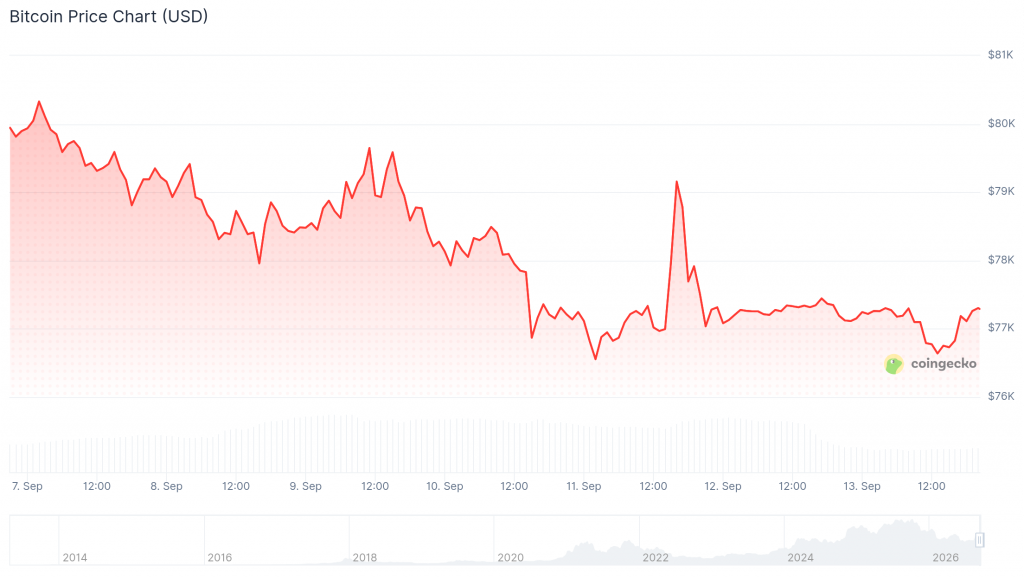
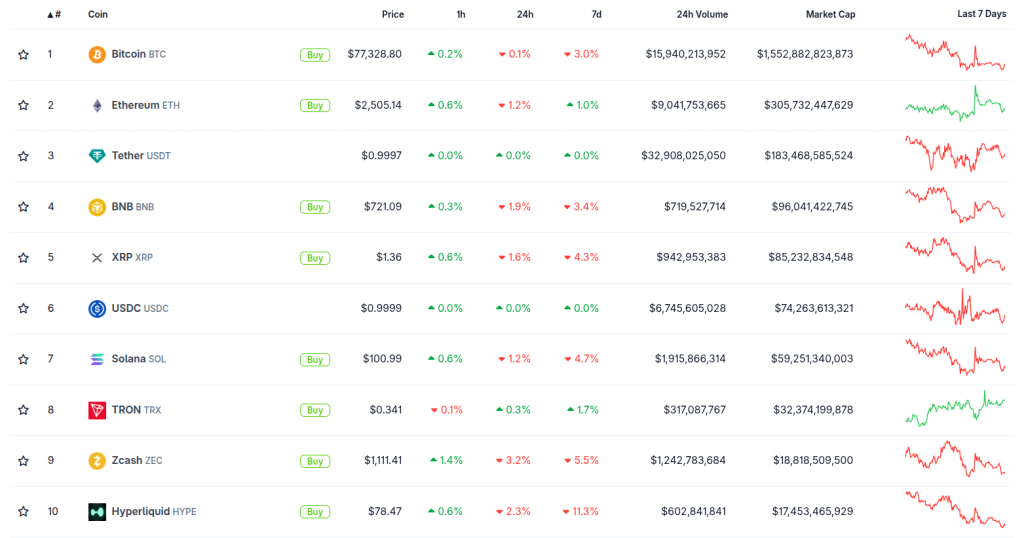
Bitcoin (BTC) closed lower for the week of Sept. 7–13, falling about 3% as the market digested hotter inflation data and repositioned ahead of the Federal Reserve’s Sept. 15–16 meeting. BTC opened near $80,340 and spent most of the week moving lower, hitting a low around $76,393 before stabilizing in the mid-$77,000s. It was trading around $77,300 at press time Sunday, with the week’s range stretching from roughly $76,393 to $80,494. The decline followed a strong August rally and left Bitcoin struggling to regain the $80,000 level.
Friday, Sept. 11, provided the week’s clearest attempt at a recovery. Bitcoin initially fell to around $76,200 after the release of August CPI, then reversed sharply and climbed toward $80,000, briefly reaching roughly $79,900. The rally wiped out most of the week’s losses in a matter of hours but could not hold. Selling returned near $80,000 and BTC gave back much of the move, closing around $77,200. The sharp reversal suggested that traders were still willing to buy the dip, but that the area around $80,000 remained difficult to break.
| Put your Bitcoin price predictions to the test and build a track record — check out Glimpse, the Bitcoin-native prediction market. |
The broader market was being pulled in different directions by the U.S. macro backdrop. August PPI, released Thursday, showed producer prices rising 0.4% month over month and 5.4% year over year, helping trigger Bitcoin’s steepest daily decline of the week. CPI the following day came in at 0.4% month over month, while rising oil prices, higher Treasury yields and hawkish Federal Reserve signals pushed markets to price a greater chance of a September rate hike. U.S. spot Bitcoin ETFs recorded about $462.7 million in net outflows during the week, their largest weekly withdrawal in 10 weeks, including $282.7 million on Thursday and another $13.29 million on Friday.
Major altcoins mostly followed Bitcoin lower, although Ethereum (ETH) stood out for its relative strength. ETH was roughly flat on the week, ending up 1% near $2,500–$2,510, while Solana (SOL) fell about 5% to $101, XRP about 4.3% to $1.36, and BNB about 4% to $721. Zcash (ZEC), which last week broke above $1,200, is down 5.5% over the past seven days, currently changing hands at around $1,111, while Hyperliquid (HYPE) fell as much as 11% over the same period of time, down to about $78.50.
ETF flows also showed some rotation: Ethereum funds attracted about $216 million on Friday even as Bitcoin ETFs saw a small outflow, while XRP funds continued to attract money.
Bitcoin’s ability to hold the mid-$76,000s after Thursday’s sell-off and Friday’s failed push through $80,000 leaves the market in a relatively narrow range heading into the Fed meeting. For now, the macro picture is doing more to set the direction than crypto-specific catalysts, with the FOMC decision, rate guidance and the Senate’s CLARITY Act proceedings among the main events ahead.
Why it matters: Bitcoin showed buyers are still willing to step in after sharp drops, but the failed Friday rally and renewed ETF outflows suggest the market needs a stronger catalyst to turn the $80,000 resistance level into support.
U.S. Senate Republicans Revise CLARITY Act Ahead of Key Vote
Senate Republicans released a revised 630-page version of the Digital Asset Market CLARITY Act on Thursday, adding new provisions aimed at crypto trading protocols that claim to be decentralized while remaining subject to meaningful control by an individual or group. The updated language would require such “decentralized-in-name-only” protocols to register with the Commodity Futures Trading Commission (CFTC), extending the bill’s market-structure framework into a contentious area of decentralized finance.
Sen. Cynthia Lummis (R-Wyo.), the bill’s lead Senate sponsor, said the latest draft incorporates more than 100 changes requested by Democrats during negotiations over the August recess. The legislation is scheduled for a procedural Senate vote on Sept. 15, with 60 votes needed to advance it. Republicans hold 53 seats, meaning the bill will need Democratic or independent support to clear the hurdle.
This updated Clarity Act text reflects bipartisan hard work over August—specifying when decentralized-in-name-only DeFi protocols must register with the CFTC and limiting the DeFi provisions to spot and cash transactions, in response to Native American concerns about prediction…
— Senator Cynthia Lummis (@SenLummis) September 10, 2026
In the meantime, POLITICO reported that President Donald Trump met with advisers on Friday to discuss ethics provisions under consideration for the CLARITY Act. The closed-door meeting came four days before the Senate’s procedural vote and focused on language that Democrats have pushed to constrain potential conflicts involving Trump and his family’s crypto interests. No decision from the meeting had been disclosed as of Sunday.
The ethics provisions remain among the issues complicating bipartisan negotiations over the bill. Despite the uncertainty, White House crypto adviser Patrick Witt struck an optimistic tone Saturday, posting that it was a “bad day to be a Clarity Act doomer.”
Why it matters: The revised DeFi language could establish a federal test based on actual control rather than how a protocol markets itself, while the Sept. 15 vote may determine whether the U.S. gets a comprehensive crypto market-structure framework this year. Trump’s involvement also reflects how closely the bill’s regulatory framework is tied to political and ethics disputes, but Witt’s comments suggest the administration still expects the legislation to have a path through the Senate.
Revolut Exposed Bitcoin Transaction Histories in Fake Government Data Request Scam
Fintech company Revolut confirmed a customer data breach after a malicious actor impersonated a government agency and submitted fraudulent information requests using an unauthorized email account on the agency’s legitimate domain. Because the messages carried valid domain authentication credentials, Revolut initially treated the requests as genuine and provided customer information.
“Revolut recently identified a sophisticated external impersonation scam where an unauthorised third party utilised a legitimate government agency domain email to submit fraudulent requests for information,” a company spokesperson told TechCrunch.
The exposed records included names, dates of birth, occupations, addresses, email addresses and phone numbers, as well as identity documents and verification selfies. Revolut said biometric facial telemetry was not involved. The company did not disclose which government agency was impersonated or how many customers were affected, describing the number as limited.
For crypto users, the disclosure of financial records is particularly concerning. The information, obediently provided to the attacker, included account statements containing IBANs and wallet reference numbers, withdrawal records and complete transaction histories, including Bitcoin activity. Revolut said its systems were not compromised and customer funds were unaffected, and said it had blocked the offending email address and notified the relevant agency, law enforcement and regulators.
Crypto investigator ZachXBT said the incident appeared to involve high-net-worth users, raising concerns about the physical-security implications of exposing identities alongside detailed Bitcoin holdings and transaction histories. The incident comes amid a rise in so-called wrench attacks, in which criminals target crypto holders through physical coercion or violence to obtain their assets.
In a separate, but similar incident earlier this week hardware wallet maker Trezor warned users that hackers compromised its third-party email provider and used access to send a phishing email disguised as a critical security alert. The fraudulent message, titled “Critical Security Alert: STM32 Entropy Vulnerability,” falsely claimed that a hardware-level flaw in STM32 microcontrollers affected around one in four devices and could compromise the randomness used to generate recovery phrases. The Czech manufacturer stressed the email did not originate from the company and urged recipients not to click its links.
The incident was reported by users hours before Trezor’s warning, while Casa CEO Nick Neuman said the campaign could extend beyond Trezor, citing reports from BitBox users. The phishing message appeared designed to exploit concerns following a recent Coldcard-related exploit that resulted in more than $130 million in Bitcoin losses.
There are convincing phishing emails going out right now from hardware wallet companies (have heard Trezor and Bitbox at least). It’s likely that a marketing email provider was compromised. That will mean more customer emails are leaked.
Stay frosty and don’t trust provider… pic.twitter.com/jHtdRE9S2A
— Nick Neuman (@Nneuman) September 9, 2026
Why it matters: The breach shows how KYC databases can become a security liability even when a financial platform’s own systems and customer funds remain intact, particularly when identity records are linked to detailed Bitcoin holdings and transaction histories.
Crypto Heist Suspected in Killing of Mexican Musician and Family
A suspected cryptocurrency robbery was allegedly behind the killings of Mexican musician Jonathan Meléndez, his pregnant wife, their three-year-old daughter and a domestic worker at the family’s home in Atizapán de Zaragoza, State of Mexico, on Sept. 1. According to a report by IBTimes UK, prosecutors believe the attackers were searching for a cold wallet they believed held millions of dollars worth of Bitcoin. The couple’s six-year-old son survived the attack.
Authorities arrested two suspects the following day, identifying them as Diego Sebastián and Gerardo. Prosecutors allege that Sebastián, a business associate of Meléndez, used his relationship with the musician to gain access to the home and offered Gerardo 2 million pesos, roughly $118,000, to help obtain the cryptocurrency. The investigation remains ongoing, and the allegations have not been tested in court.
Why it matters: The horrific incident underscores the physical security risks that can arise when criminals believe someone holds substantial amounts of Bitcoin, particularly when access to self-custodied funds is perceived to depend on a wallet or its recovery credentials.
Coinbase Wallet is Back
Coinbase is reverting the name of its Base App to Coinbase Wallet, ending a social-first branding strategy introduced just over a year ago as the product shifts its focus back toward multichain trading. The change reflects the broader expansion of the wallet beyond its original role as a self-custody tool.
Ryan Kass, Coinbase’s head of product for Coinbase Wallet, said the rebrand reflects how the product has evolved rather than a retreat from its recent direction.
“The rebrand back to Coinbase Wallet is a representation that you can access any asset, regardless of what chain it’s on, regardless of the brand of asset on crypto,” Kass told Decrypt.
Base App is now Coinbase Wallet.
Built for speed. Trade anything, anywhere, without asking permission. pic.twitter.com/Z1tlIWyI4X
— Coinbase Wallet (@CoinbaseWallet) September 10, 2026
The wallet now supports more than 10 networks, including Robinhood Chain and Monad, and has expanded into perpetual futures, prediction markets and tokenized stocks. Coinbase has also added perpetual futures through Hyperliquid and expanded support for tokenized equities across multiple chains, pushing the wallet toward a broader trading hub rather than a primarily social crypto application.
Coinbase Wallet remains self-custodial, meaning users hold their own private keys rather than entrusting them to Coinbase.
Why it matters: Coinbase is positioning its wallet as a single multichain trading interface for increasingly diverse onchain assets, reflecting the industry’s move from standalone crypto wallets toward full-service financial platforms.
Consensys Splits Into Two Companies as MetaMask Goes Independent
Ethereum-focused Consensys Software Inc. is splitting into two independently operated companies, separating its consumer-facing MetaMask wallet business from its Ethereum infrastructure and institutional operations. Under the planned restructuring, the existing entity will be rebranded as MetaMask, with founder Joe Lubin serving as chairman and CEO, while a newly formed company will retain the Consensys name. The separation is expected to be completed by the end of 2026.
Today, Consensys Software Inc. (CSI) is becoming two independent companies.
CSI will continue as the same company and rebrand as MetaMask, operating the MetaMask platform and its consumer-facing products, with Joe Lubin as Chairman and CEO.
CSI’s Protocols Group and…
— Consensys.eth (@Consensys) September 9, 2026
The new Consensys will house the company’s Ethereum protocol and institutional infrastructure businesses, including Linea and other blockchain infrastructure operations. The restructuring gives MetaMask a standalone corporate identity as it focuses on consumer self-custody and financial products, while Consensys concentrates on protocol development and institutional blockchain infrastructure.
Why it matters: The split marks a significant strategic separation between MetaMask’s consumer wallet business and Consensys’ infrastructure ambitions, giving each company a more focused path for growth.
Nasdaq Invests $100M in Kraken Parent Company Payward
Nasdaq is investing $100 million in Payward, the parent company of crypto exchange Kraken, as the stock exchange operator deepens its push into tokenized securities. The investment, made through Nasdaq Ventures, follows a partnership announced in March and comes with a target of launching tokenized versions of Nasdaq-listed stocks in the second quarter of 2027.
The central product of the partnership is the Nasdaq Equity Token, or NET—a blockchain-based representation of a publicly listed share that, unlike most tokenized equity products on the market, comes with full voting rights intact.
The deal also expands the companies’ relationship beyond tokenization. Payward will deploy Nasdaq’s market-surveillance technology across its crypto, equities, futures, options and tokenized-equity venues. Bloomberg reported that the investment values Payward at about $21 billion, although Nasdaq did not confirm the valuation, the size of its stake or whether it received governance rights.
Why it matters: Nasdaq’s investment puts institutional market infrastructure directly behind Kraken’s expansion into tokenized equities, bringing regulated-market surveillance closer to crypto-native trading platforms.
Block Seeks Federal Trust Bank Charter for Bitcoin Custody
Block, the payments company behind Square and Cash App, has applied to the U.S. Office of the Comptroller of the Currency (OCC) to establish Builders Bank & Trust, an uninsured national trust bank focused on digital-asset custody and related fiduciary services. Subject to regulatory approval, the proposed bank would custody bitcoin, stablecoins and other digital assets, but would not accept deposits or make loans.
The application would give Block a single federal regulatory framework for custody activities that currently operate across a patchwork of state licenses. Block processed about $10.7 billion in Bitcoin volume last year across more than 50 state licenses. The company already operates Square Financial Services under an industrial loan company charter, but the proposed trust bank would be a separate entity under direct OCC supervision.
Why it matters: Block’s move adds another major U.S. fintech to the growing push for federally regulated digital-asset banking, signaling that Bitcoin custody is increasingly being treated as a mainstream financial service rather than a specialized crypto offering.
Join us at the Greater Columbus Convention Center on September 23rd and 24th, 2026, for a deep dive into the future of decentralized finance. The Midwest Bitcoin Summit is a dedicated space for builders, investors, and enthusiasts to connect in the heart of Ohio.
Whether you are looking to network in our Business Hall, relax in the VIP Lounge, or catch keynote speakers on the Main Stage, this summit is designed to provide institutional-grade insights with the grassroots energy of the Bitcoin community.
Save 21% on tickets with code BTCHQ
