

Bitcoin extends losses amid Supreme Court ruling, escalating trade policy uncertainty, and relentless ETF outflows, raising fresh questions about the asset’s role as a macro hedge.
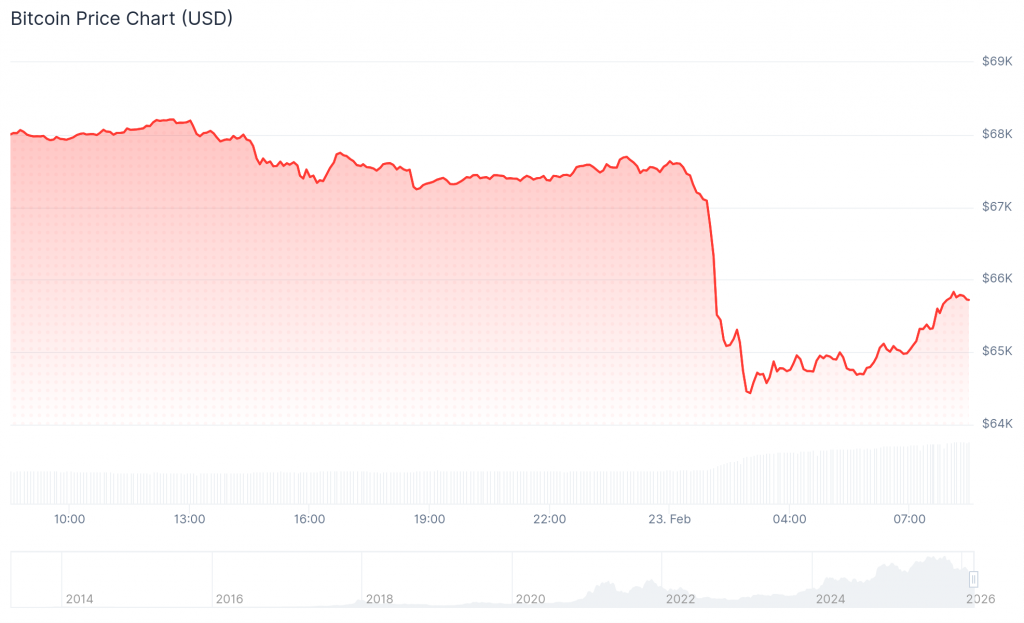
Bitcoin (BTC) fell as much as 4.8% in early Asian trading on Monday, touching $64,300 — its lowest level since February 6 — as renewed turbulence in U.S. trade policy compounded an already fragile risk environment. The move erased another $100 billion in total crypto market value within a 24-hour window, according to CoinGecko data, deepening a selloff that has now wiped more than $2 trillion from the broader digital asset market since its peak. By 9am CET, Bitcoin had partially recovered to around $65,950, though sentiment remained acutely negative across both crypto and traditional markets.
A Weekend of Policy Whiplash
The immediate catalyst for the selloff was a Supreme Court ruling that struck down President Donald Trump’s invocation of emergency authority to impose tariffs, casting doubt on the legal durability of his broader trade agenda. Rather than signaling a retreat, Trump responded on social media Saturday by announcing he would raise his previously declared global 10% tariff to 15% — a move that injected fresh uncertainty into markets already struggling to price a coherent policy trajectory.
On Sunday, U.S. officials sought to contain the damage, stating that trade deals already negotiated with partners remain intact. The reassurance did little to stabilize sentiment. By Monday’s Asian open, S&P 500 futures were down 0.8%, Nasdaq 100 futures had fallen 1%, and the dollar weakened — a combination that typically signals broad risk-off positioning rather than a rotation into safe havens.
Ether (ETH) fell 5.2%, underperforming Bitcoin, while smaller-cap tokens bore the steepest losses — consistent with a pattern of accelerated capital flight from higher-beta digital assets during periods of macro stress.
The Erosion of the Trump Premium
Monday’s move crystallized a deterioration that has been building for months. Bitcoin had surged to an all-time high above $126,000 last October, driven in large part by expectations that a second Trump administration would deliver a structurally favorable regulatory environment for digital assets — friendlier SEC leadership, a potential strategic Bitcoin reserve, and legislative clarity on stablecoins and market structure. That premium has now been almost entirely unwound.
The scale of the reversal is significant. From peak to current levels, Bitcoin has shed roughly 48% of its post-election gains. The broader crypto market’s $2 trillion drawdown mirrors the kind of valuation destruction typically associated with credit crises or systemic risk events — not a policy-driven macro correction.
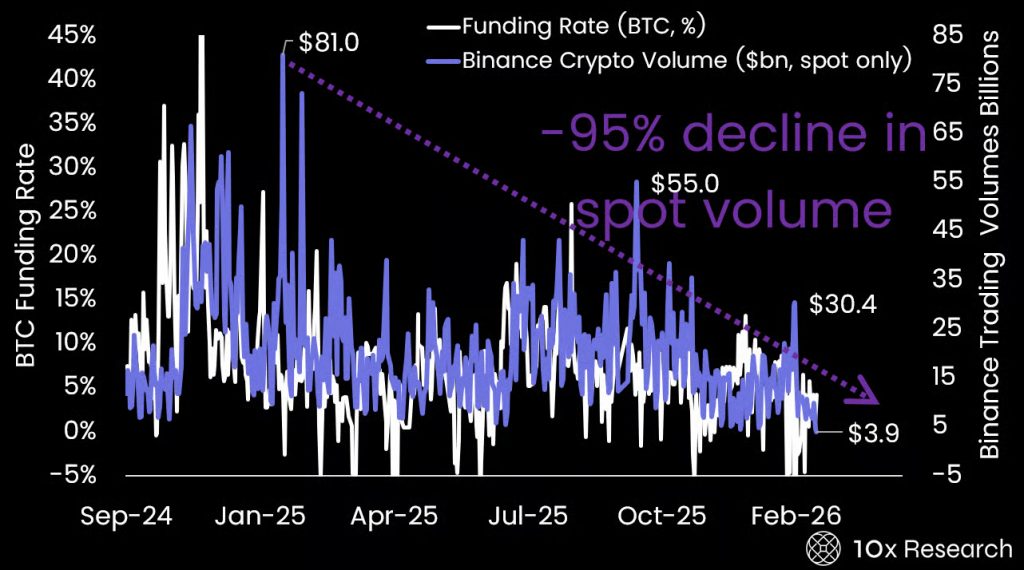
Volumes tell a similarly stark story. According to data from 10x Research, spot trading volumes on Binance, the world’s largest crypto exchange by market share, have collapsed by approximately 95% since Trump’s inauguration. While some of that decline reflects seasonal normalization and exchange-specific dynamics, the magnitude suggests a deeper pullback in speculative participation — a hallmark of a market transitioning from euphoria to risk aversion.
ETF Flows: Institutional Sentiment Turns Cautious
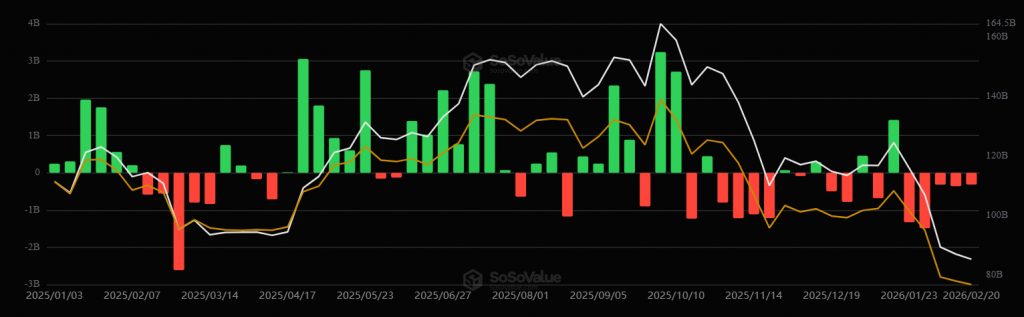
Perhaps the most structurally significant signal is the behavior of U.S.-listed spot Bitcoin ETFs, which were widely heralded as a watershed moment for institutional adoption when they launched in early 2024. The dozen approved funds recorded their fifth consecutive week of net outflows — the longest such streak since February of last year — with investors pulling a cumulative $3.8 billion over that period.
This sustained outflow pattern is notable for several reasons. It suggests that the institutional bid, which provided critical support during Bitcoin’s ascent above $100,000, is no longer reliably absorbing selling pressure. It also implies that macro-sensitive allocators — the same investors who embraced Bitcoin ETFs as a portfolio diversifier or inflation hedge — are de-risking in response to the same tariff and growth concerns weighing on equities.
 Source: SoSoValue
The correlation between Bitcoin and U.S. equity risk assets, which had begun to loosen in late 2024 as the “digital gold” narrative gained traction, appears to have reasserted itself with force. In conditions of genuine macro uncertainty, Bitcoin continues to trade as a high-beta risk asset rather than a non-correlated store of value — a distinction with meaningful implications for its long-term institutional case.
From a technical standpoint, Bitcoin’s ability to hold above $64,000 — a level that has served as meaningful support since the early February consolidation — will be closely watched. A sustained break below that threshold could open the door to a test of the $58,000–$60,000 range, which represents the next significant demand zone and aligns with the lower bound of Bitcoin’s pre-election trading range.
To the upside, a credible de-escalation in trade tensions — whether through Congressional intervention, a negotiated trade framework, or legal clarification on tariff authority — could quickly reverse risk sentiment and trigger a short-covering rally. The ETF flow dynamic is also worth monitoring: any reversal into net inflows would signal that institutional demand has returned and could provide a floor.